
Published:
Updated:
Learning Ukulele with Curt
Six Secrets of Ukulele Fingering - Motion Principles
Basic Applications of the Six Secrets of Ukulele Fingering Motion Principles.
Author(s): Curt Sheller Publisher: Curt Sheller Publications Code: UL6SUFBK-Principles
Main Category: Fingering Main Instrument: Ukulele
Categories: Chords, Fingering, Technique

2026-08-23
Show Series Lessons
Series Home
Number of Pages: 2
If you're a registered site member and have the correct permissions you can view ALL the pages of this PDF at a larger size using the LearningUkulele.com Online PDF Viewer (button below).
Download PDFThis Download is NOT part of your LearningUkulele.com & Learning Ukulele with Curt membership level.
Sign-up for Premium Site Access or Upgrade Your Plan to download this PDF or your can purchase a copy for download
Sign In for Access…Contact Us if there are any issues.
Basic Applications of the Six Secrets of Ukulele Fingering Motion Principles.
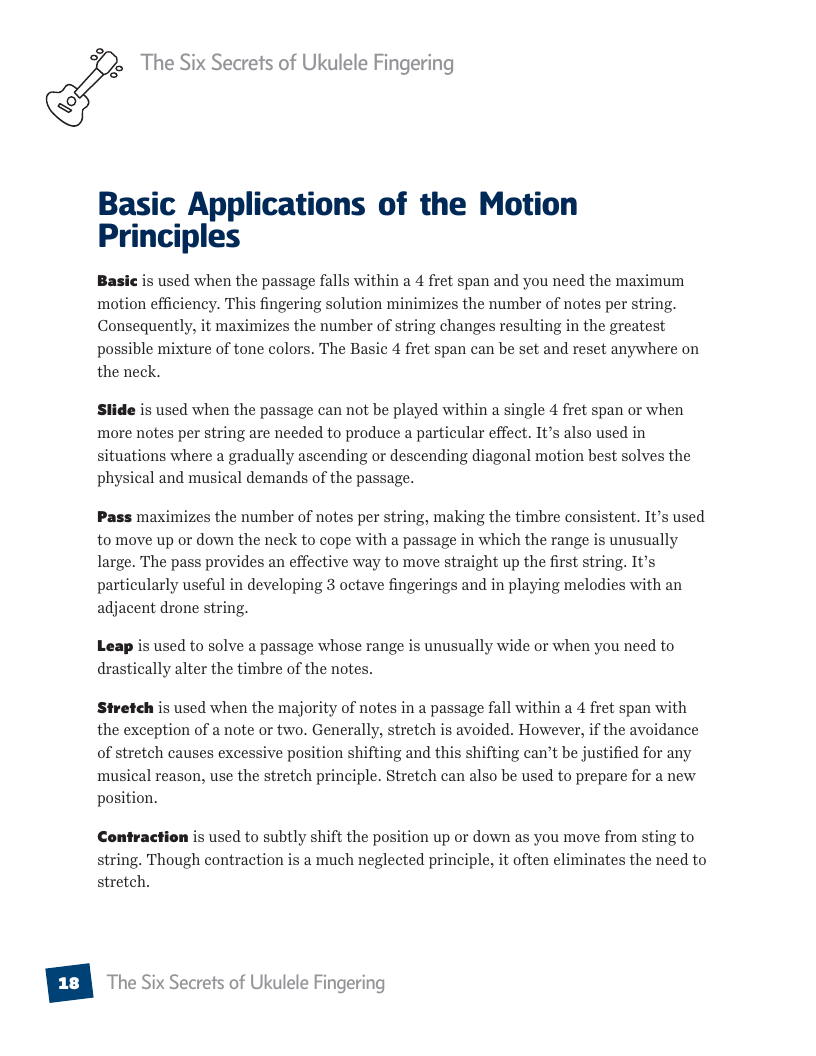
Basic is used when the passage falls within a 4 fret span and you need the maximum motion efficiency. This fingering solution minimizes the number of notes per string. Consequently, it maximizes the number of string changes resulting in the greatest possible mixture of tone colors. The Basic 4 fret span can be set and reset anywhere on the neck.
Slide is used when the passage can not be played within a single 4 fret span or when more notes per string are needed to produce a particular effect. It’s also used in situations where a gradually ascending or descending diagonal motion best solves the physical and musical demands of the passage.
Pass maximizes the number of notes per string, making the timbre consistent. It’s used to move up or down the neck to cope with a passage in which the range is unusually large. The pass provides an effective way to move straight up the first string. It’s particularly useful in developing 3 octave fingerings and in playing melodies with an adjacent drone string.
Contraction is used to subtly shift the position up or down as you move from sting to string. Though contraction is a much neglected principle, it often eliminates the need to stretch.
Stretch is used when the majority of notes in a passage fall within a 4 fret span with the exception of a note or two. Generally, stretch is avoided. However, if the avoidance of stretch causes excessive position shifting and this shifting can’t be justified for any musical reason, use the stretch principle. Stretch can also be used to prepare for a new position.
Leap is used to solve a passage whose range is unusually wide or when you need to drastically alter the timbre of the notes.
More Six Secrets of Ukulele Fingering - Motion Principles
content below, continue exploring...
More Six Secrets of Ukulele Fingering - Motion Principles
Stretch is used when the majority of notes in a passage fall within a 4 fret span with the exception of a note or two. Generally, stretch is avoided. However, if the avoidance of stretch causes excessive position shifting and this shifting can’t be justified for any musical reason, use the stretch principle. Stretch can also be used to prepare for a new position.
Leap is used to solve a passage whose range is unusually wide or when you need to drastically alter the timbre of the notes.


End of Lesson - Thanks, Hope You Enjoyed It!
Related Lessons, Videos, Lesson Series, Songs, Books & Reference Charts, Resources & Assets, Workshops are below.