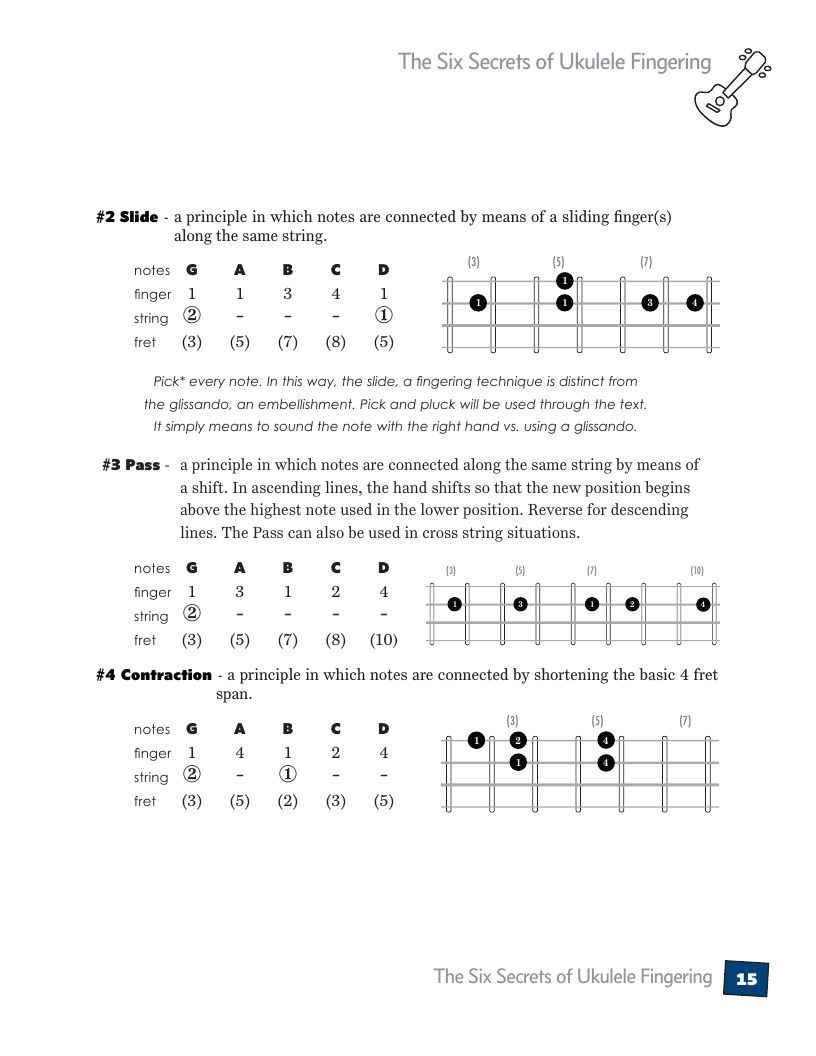
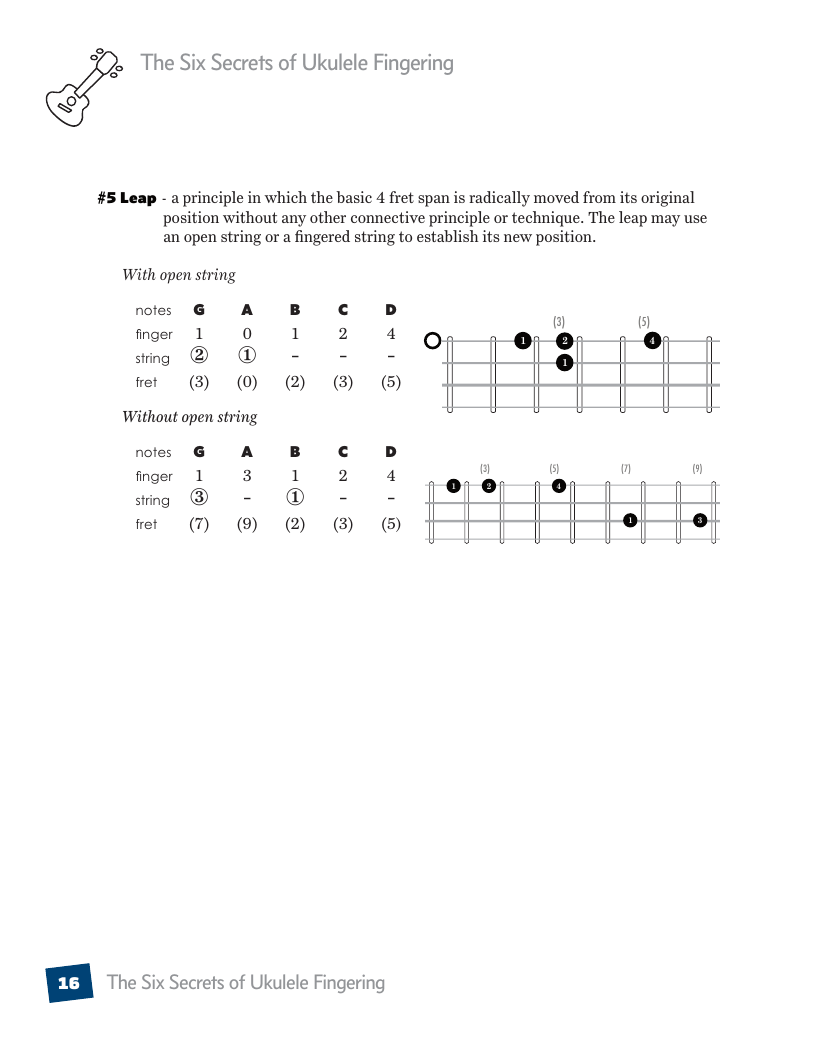
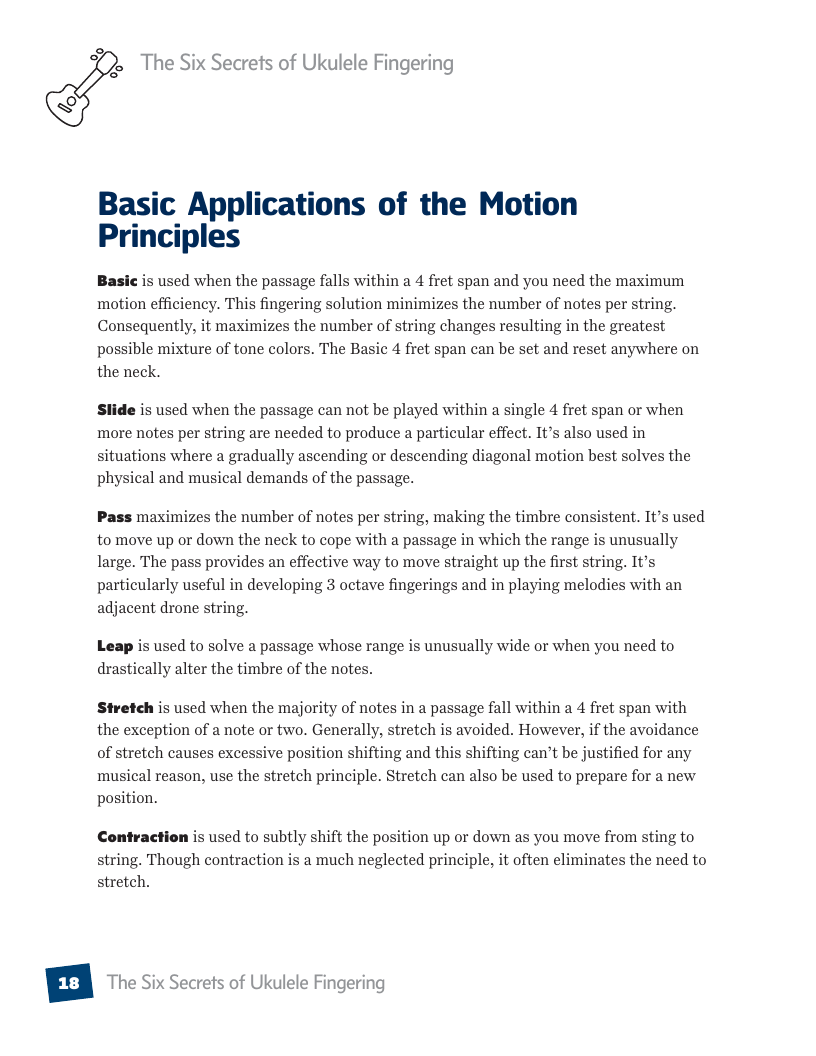
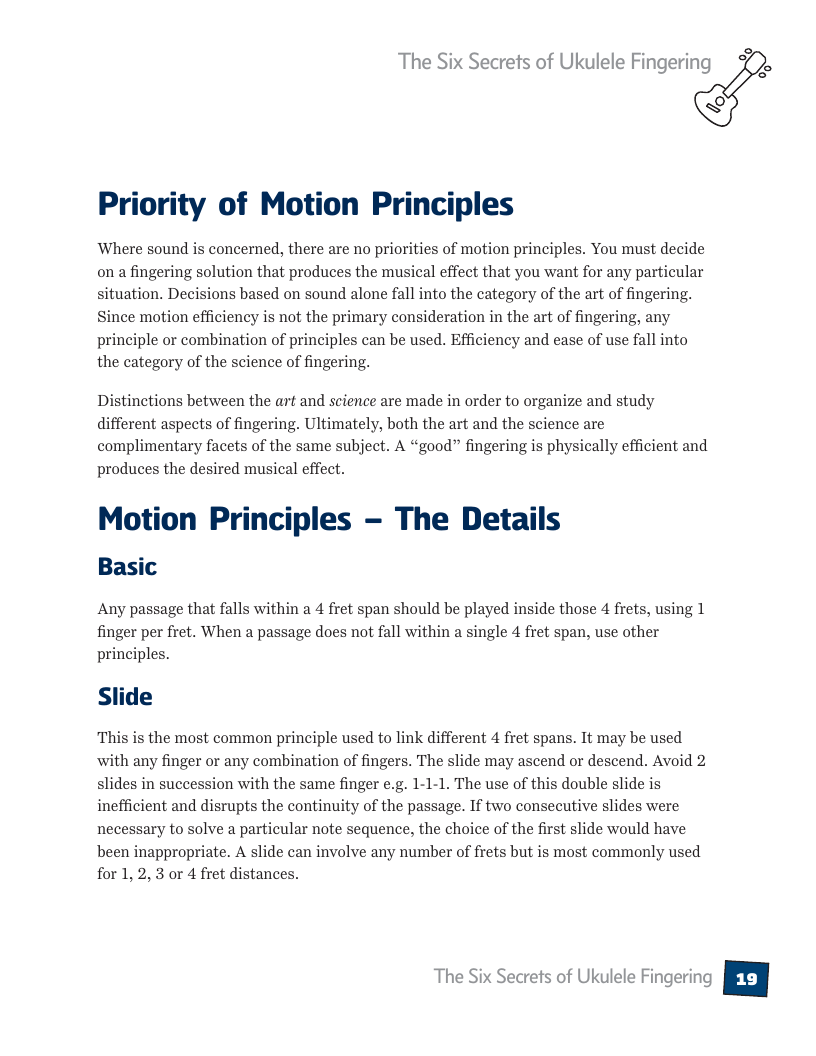
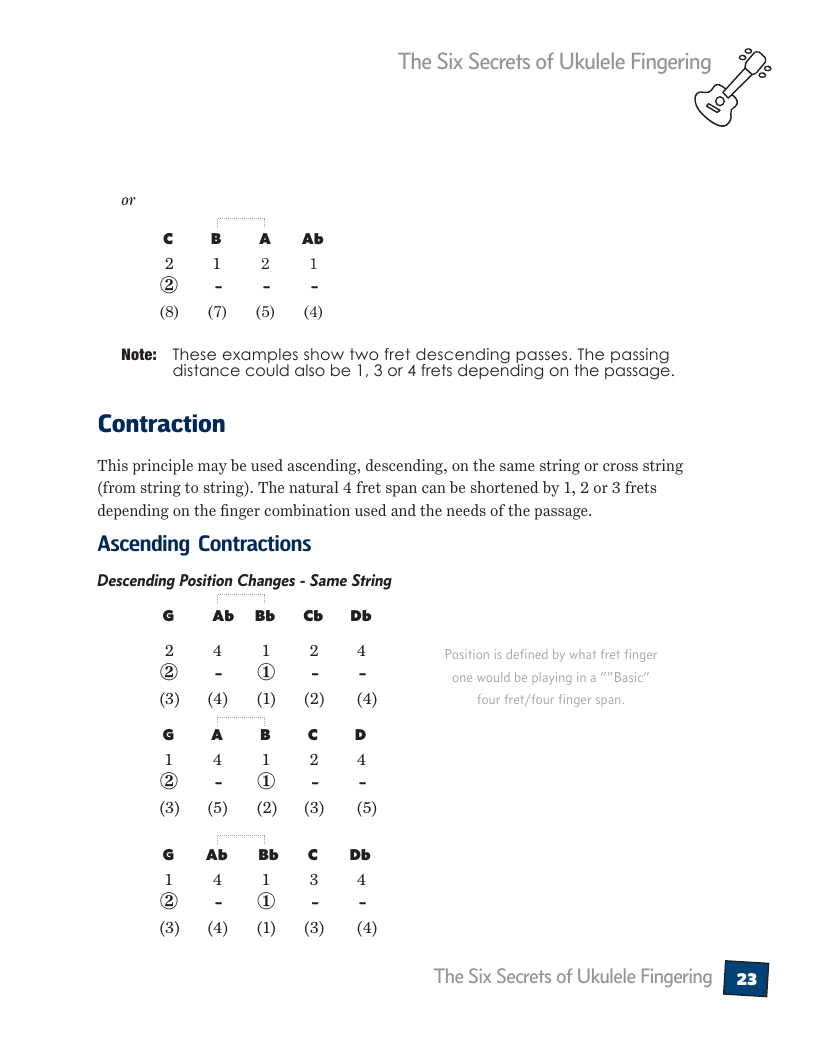
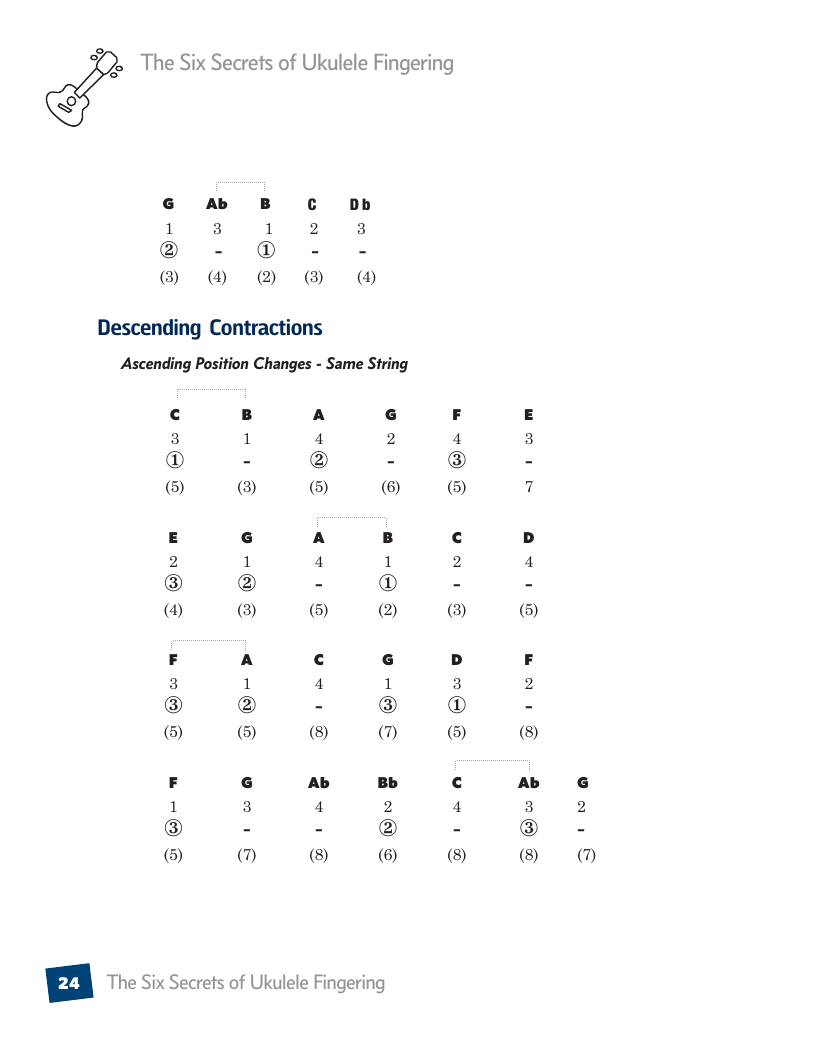
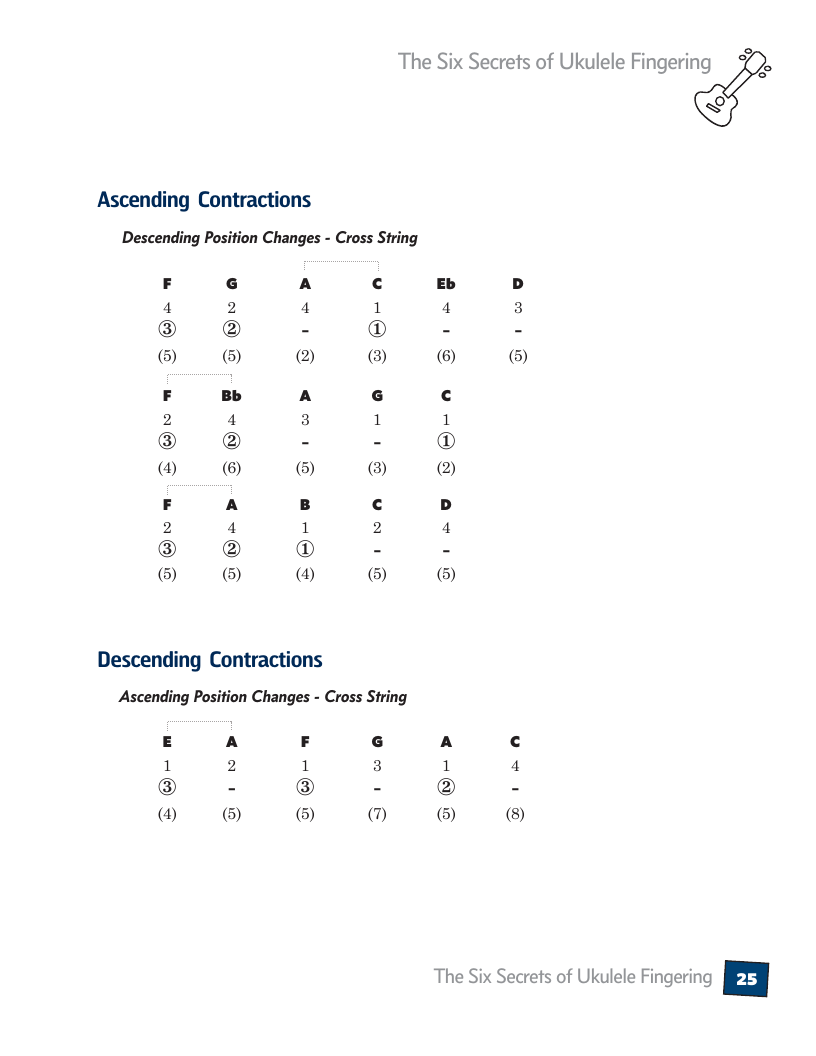
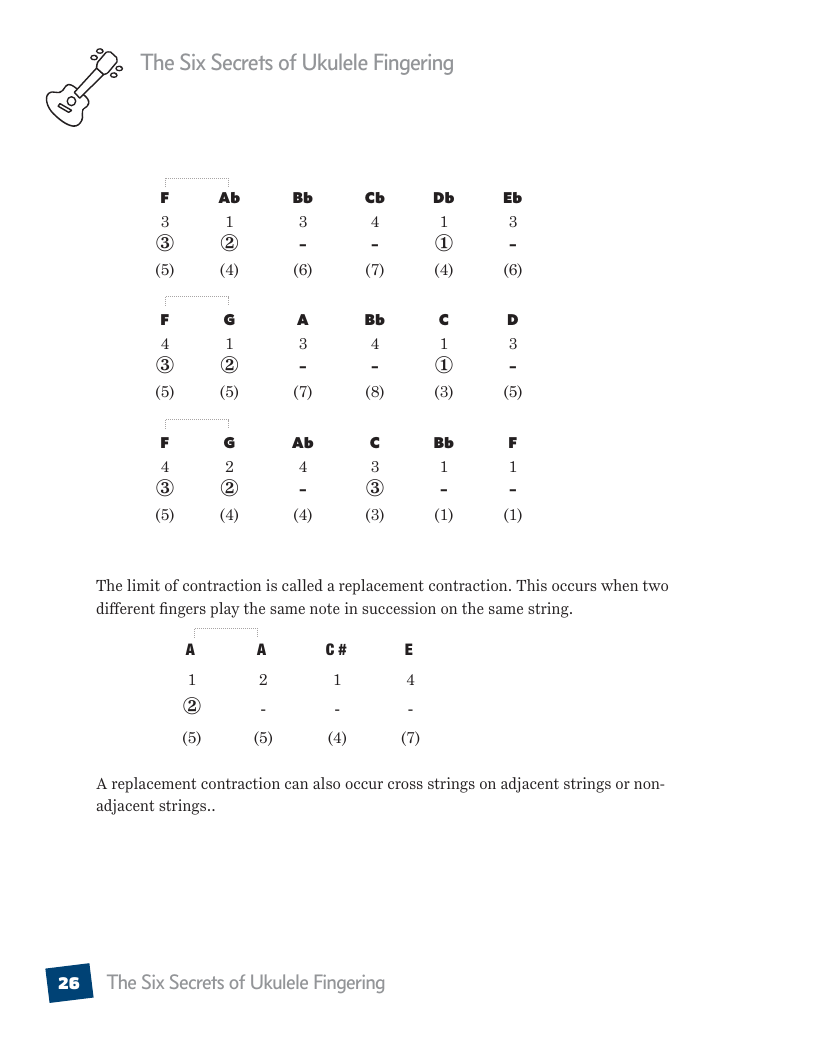
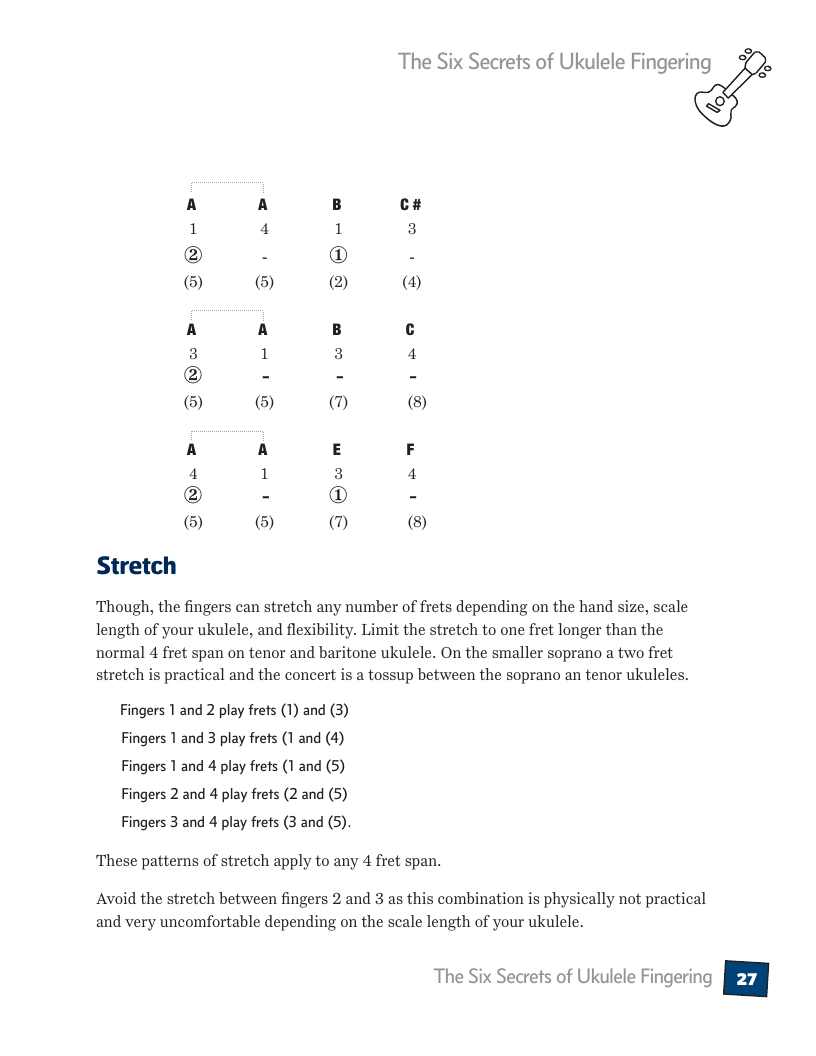
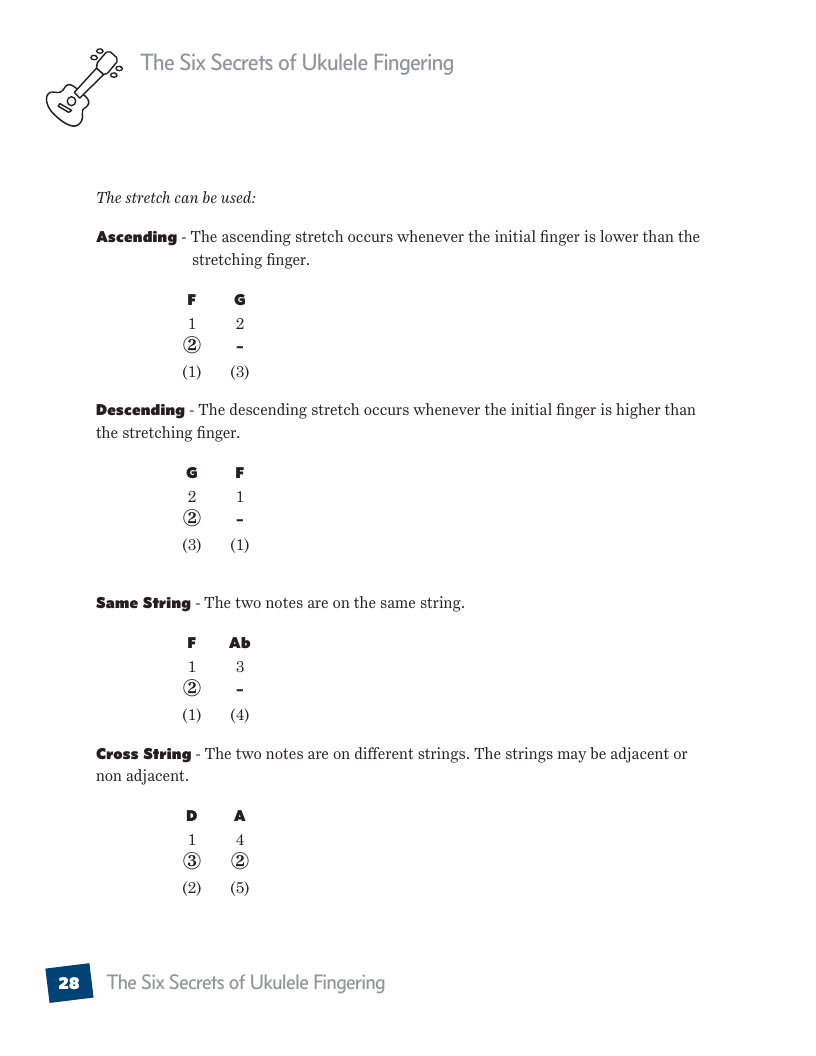
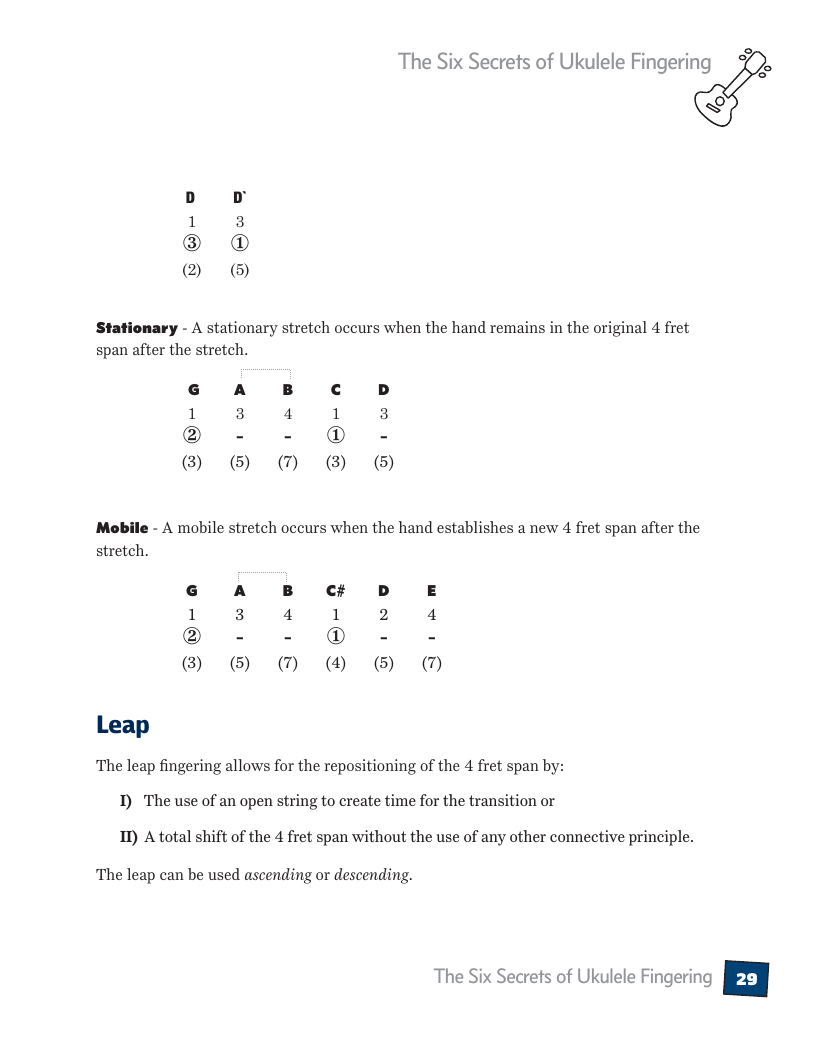
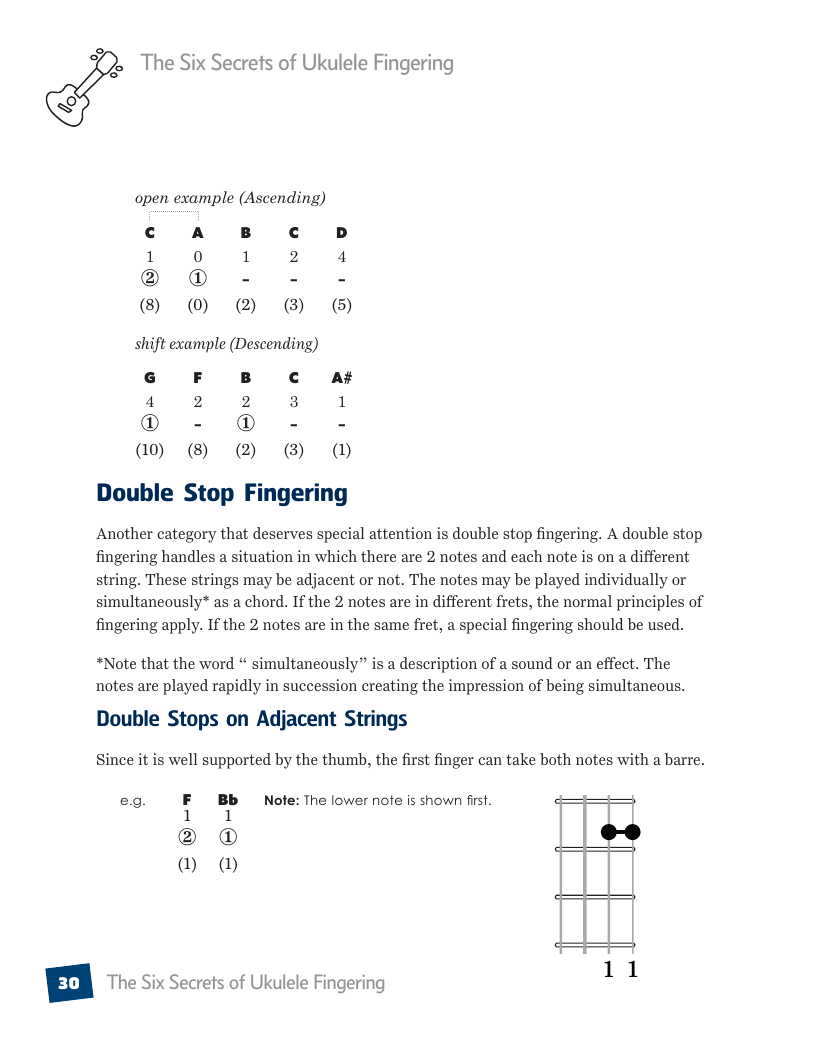
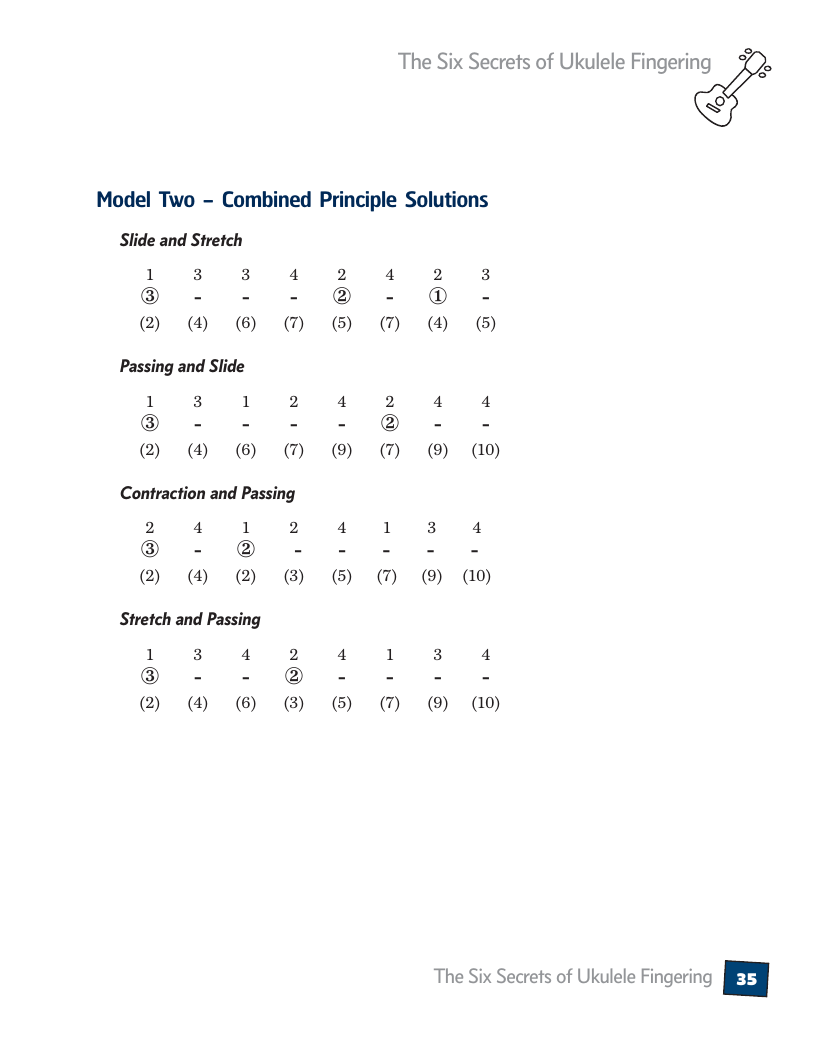
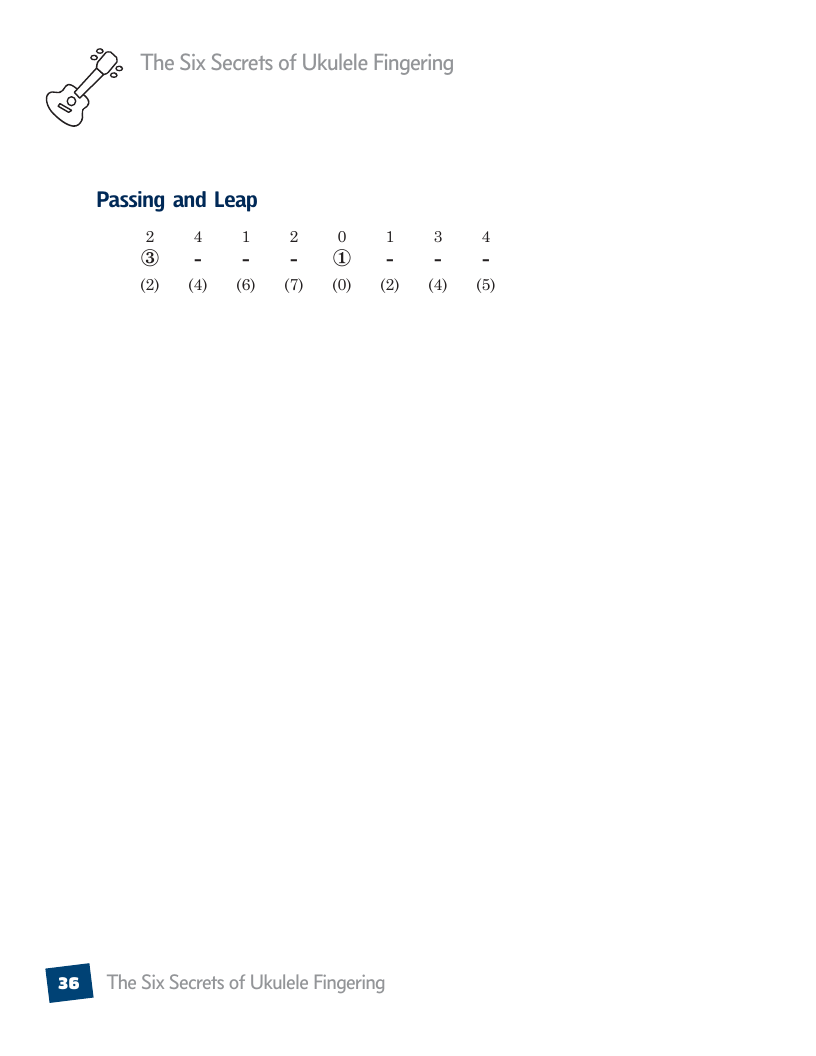
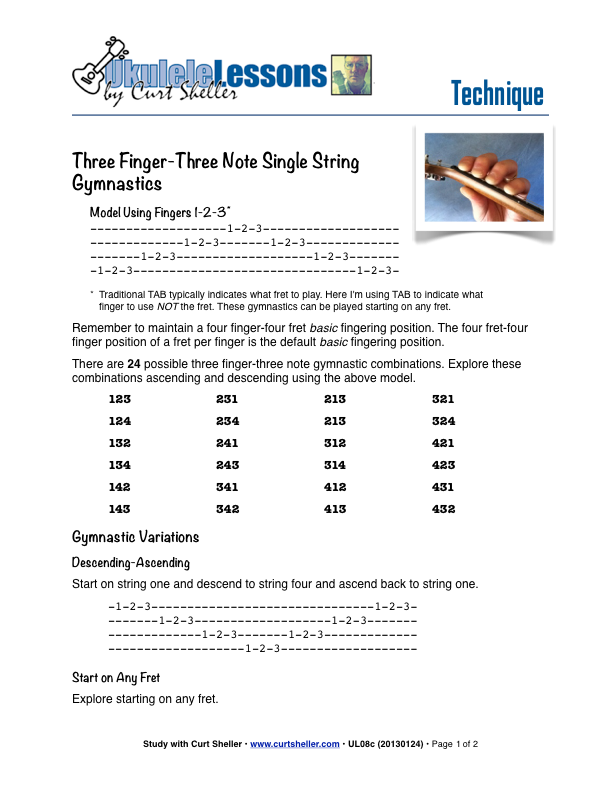
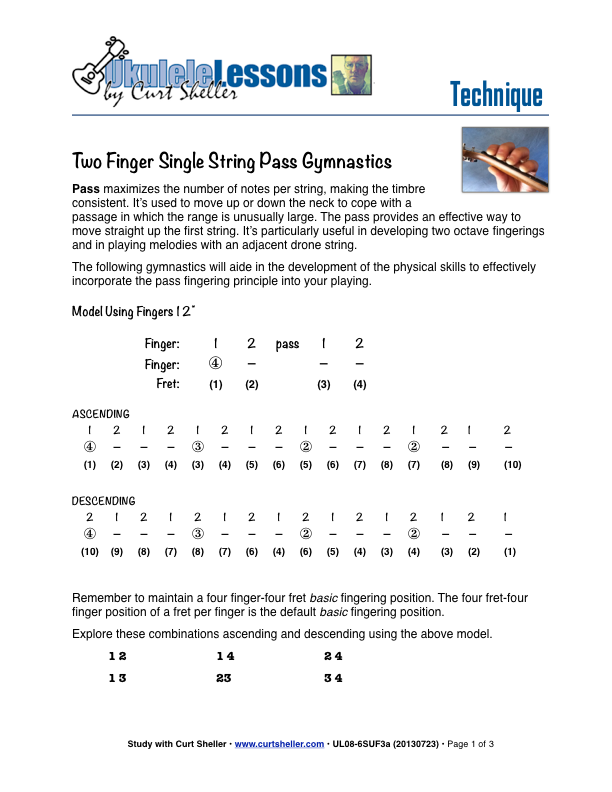
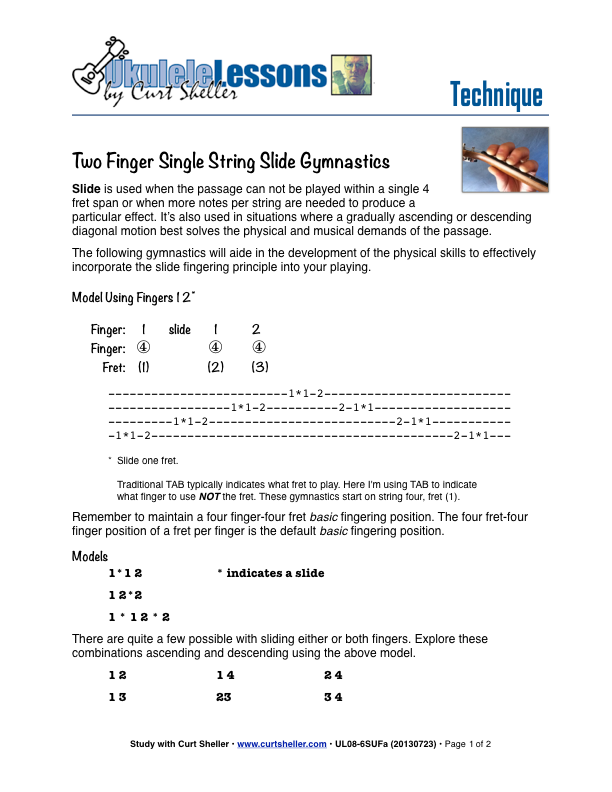
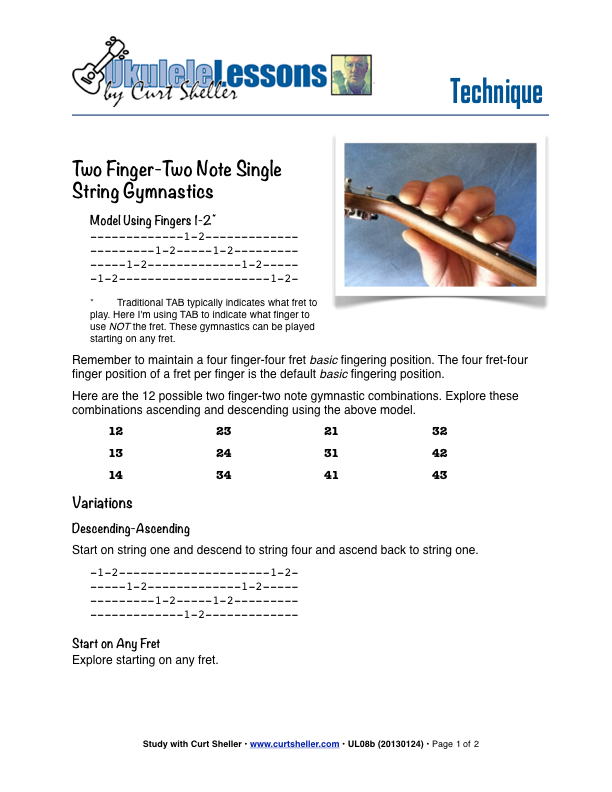
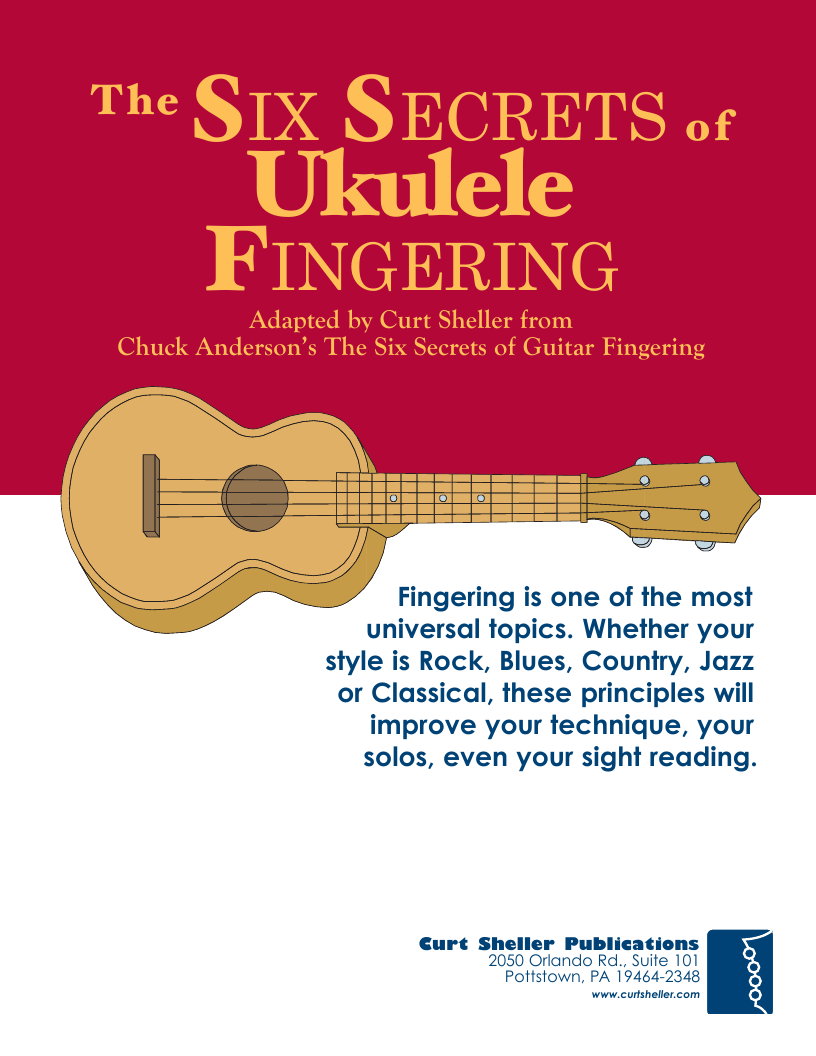
Learn the six fingering principles to navigating the ukulele fingerboard. Fingering is one of the most universal topics. Whether your style is Rock, Blues, Country, Jazz or Classical, these principles will improve your technique, your solos, even your sight reading. Think of fingering as a series of pathways. When you learn to connect these pathways, there are benefits not only to technique but also to creativity.
Publisher: Curt Sheller Publications
Authors(s):
Curt Sheller
•
Chuck Anderson
If you're a registered site member, have verified your email address, and have the correct permissions you can view ALL the pages of this PDF or Samples pages at a larger size using the LearningUkulele.com Online PDF Viewer.
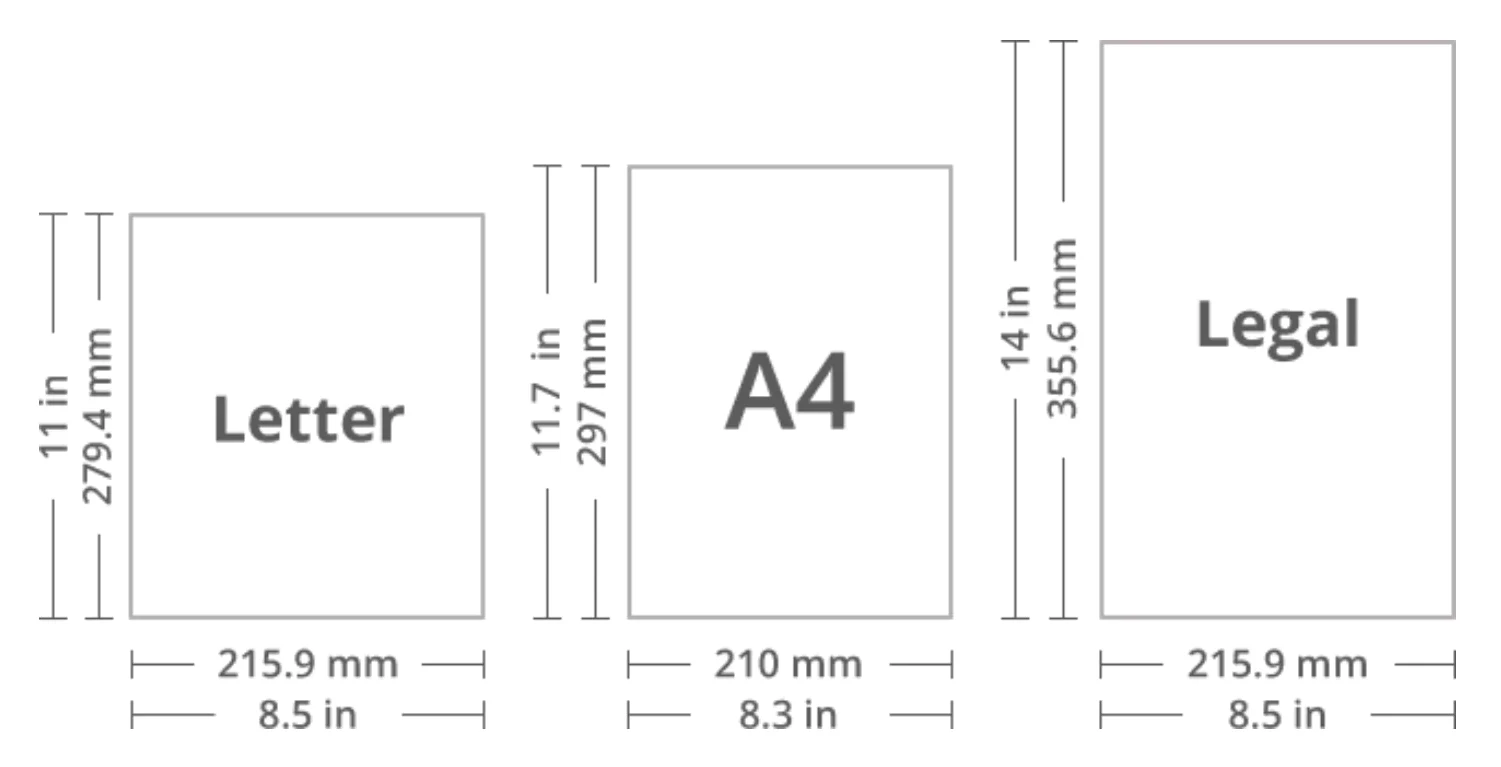
NOTE: Printing A4 to US Letter Size: As the sizes are relatively close, simple select Scale to Fit and the A4 size will print out fine.
Learn the six fingering principles to navigating the ukulele fingerboard. Fingering is one of the most universal topics. Whether your style is Rock, Blues, Country, Jazz or Classical, these principles will improve your technique, your solos, even your sight reading. Think of fingering as a series of pathways. When you learn to connect these pathways, there are benefits not only to technique but also to creativity. All fingering on the ukulele can be reduced to 6 principles of motion. Each principle has physical and musical characteristics that you can use to improve your playing.
Introduction
Fingering is one of the universal topics. Whether your style is Rock, Blues, Country, Jazz, or Classical, these principles will improve your technique, your solos, even your sight-reading.
Think of fingering as a series of pathways. When you learn to connect these pathways, there are benefits to technique and creativity. All fingering on the ukulele can be reduced to six principles of motion. Each principle has physical and musical characteristics that you can use to improve your playing.
Technically, fingering problems are inseparably linked to an instrument's tuning. A tuning's characteristics can force constant fingering adjustments and contribute to the difficulty of learning the notes on the neck. Note duplication, open strings, and unequal tuning all contribute to the complexity of fingering. Since strings vary in diameter, notes produced on different strings vary in tone color. Generally, thicker strings produce warmer or darker tone color. Thinner strings produce a brighter or more cutting tone color.
This book is devoted to applying the six fingering principles as applied to the ukulele. The study of fingering can be broken down into several topics of study. They are position and technique, finger independence and strength, and motion principles with their applications. The first step is an efficient hand position. A good hand position is critical for technique, eliminating the needless waste of effort and energy, typical of underdeveloped fingering technique.
NOTE: The fingering principles in the book are suitable for the common C, G and D ukulele tunings.
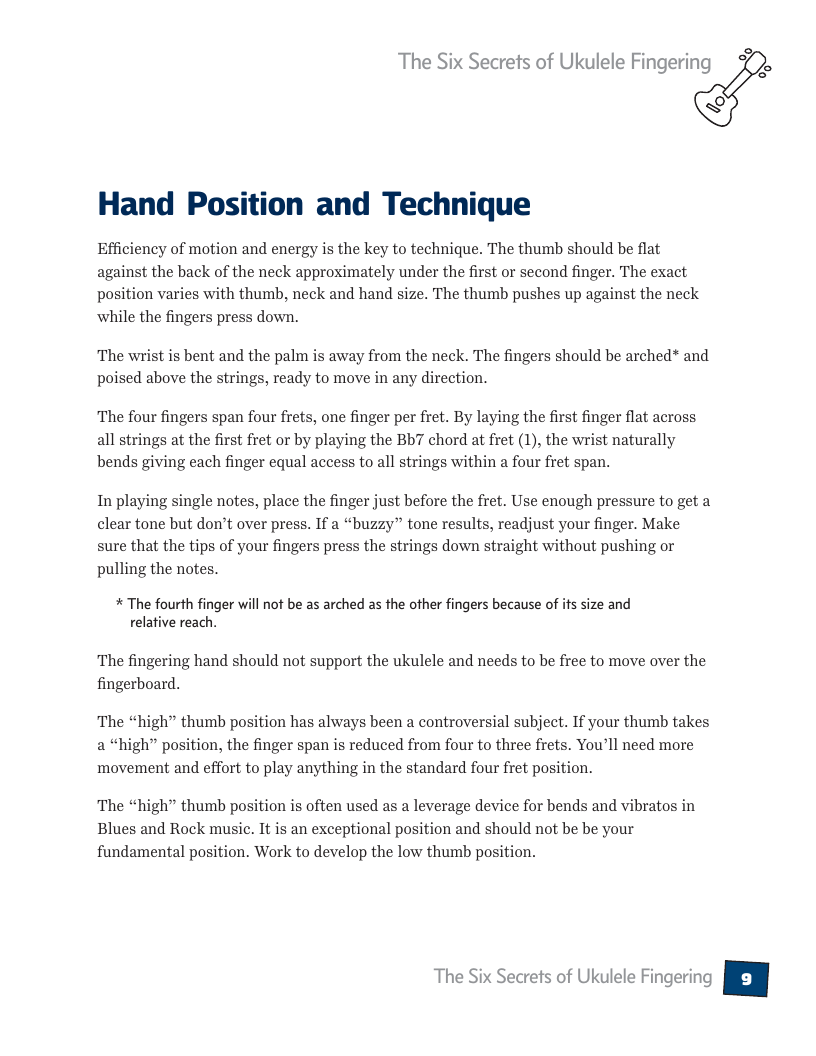
Hand Position and Technique
Efficiency of motion and energy is the key to developing your fingering technique. The thumb should be flat against the neck's back, approximately under the first or second finger. The exact position varies with the thumb, neck, and hand size. The thumb pushes up against the neck while the fingers press down and stay poised above the strings, ready to move in any direction.
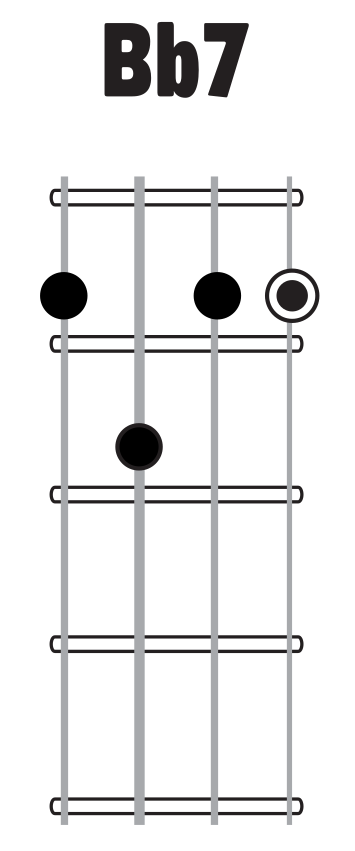
The four fingers span four frets, one finger per fret. By laying the first finger flat across all strings at the first fret or by playing the Bb7 chord at fret (1), the wrist naturally bends, giving each finger equal access to all strings within a four fret span.
In playing single notes, place the finger just before the fret. Use enough pressure to get a clear tone but don't exert more effort than required. If a "buzzy" tone results, readjust your finger. Ensure that your fingers' tips press the strings down straight, right behind the fret, without pushing or pulling the notes.
NOTE: The fourth finger will not be as arched as the other fingers because of its size and relative reach.
The fingering hand should not support the ukulele and needs to be free to move over the fingerboard.
The high thumb position has always been a controversial subject. If your thumb takes a high position, the finger span is reduced from four to three frets. You'll need more movement and effort to play anything in the standard four fret position.
The high thumb position is often used as a leverage device for bends and vibratos in Blues and Rock music. It is an exceptional position and should not be a fundamental position. Work to develop a low thumb position.
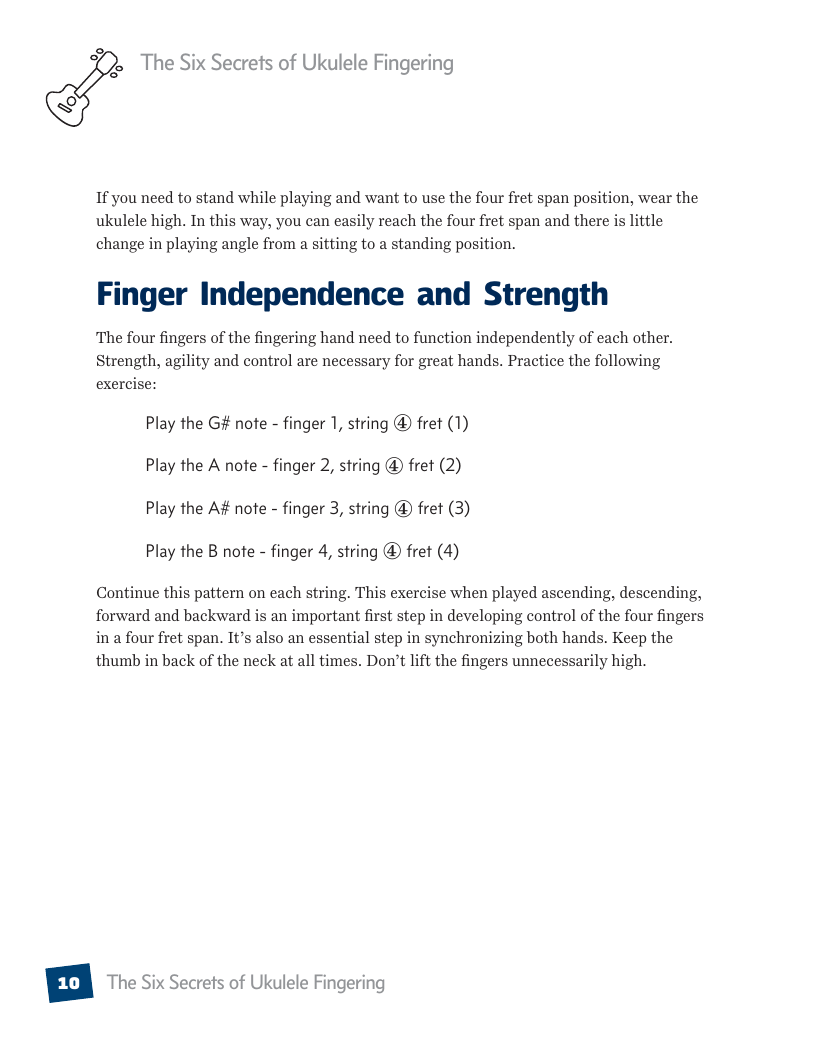
If you need to stand while playing and want to use the four fret span position, wear the ukulele high. In this way, you can easily reach the four fret span, and there is little change in playing angle from a sitting to a standing position.
Finger Independence and Strength
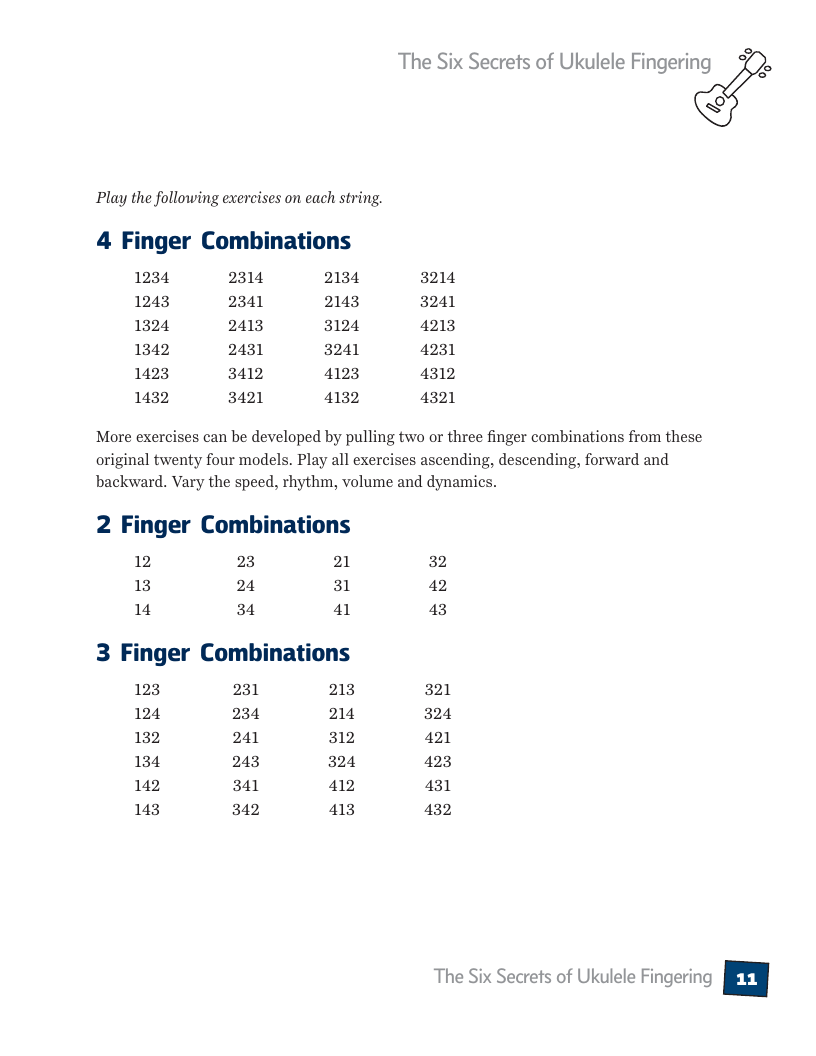
The four fingers of the fingering hand need to function independently of each other. Strength, agility, and control are necessary for great hands. Practice the following exercise:
Play the G♯ note — finger 1, string ④ fret (1)
Play the A note — finger 2, string ④ fret (2)
Play the A♯/B♭ note — finger 3, string ④ fret (3)
Play the B note — finger 4, string ④ fret (4)
Continue this pattern on each string. When played ascending, descending, forward and backward, this exercise is an important first step in developing control of the four fingers in a four fret span. It's also an essential step in synchronizing both hands. Keep the thumb in the back of the neck at all times. Don't lift the fingers unnecessarily high.
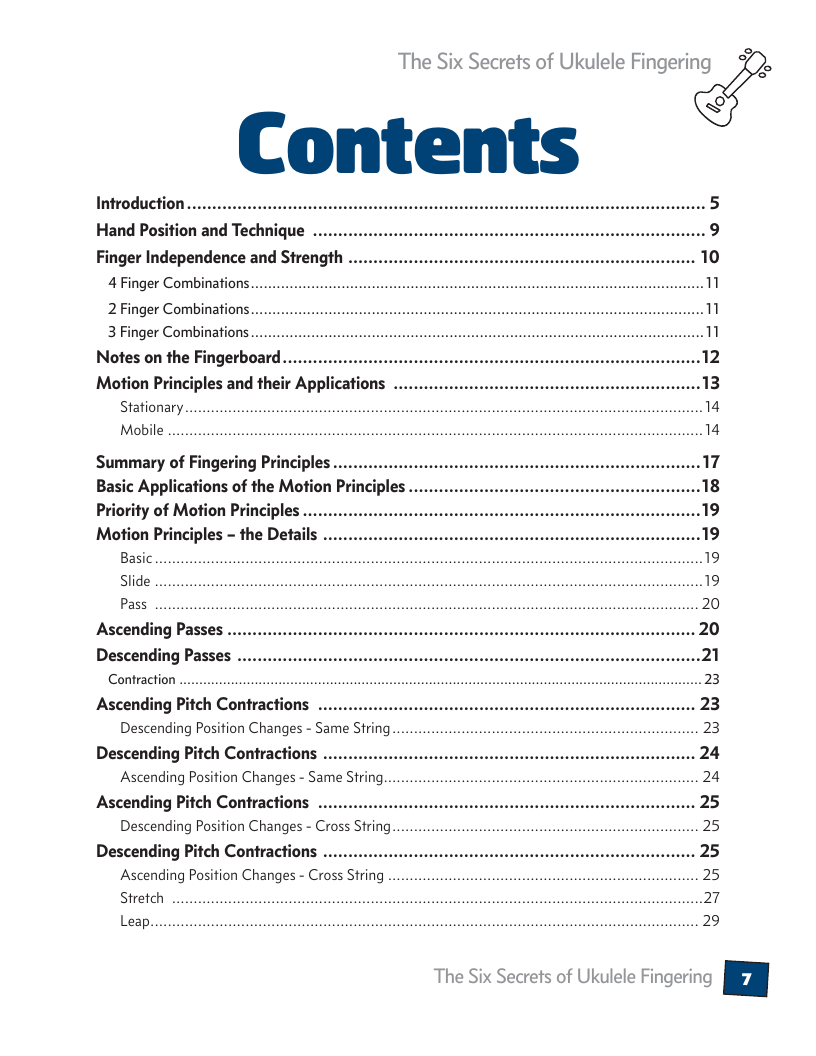
Table of Contents
Six Secrets of Ukulele Fingering
Introduction 5
Hand Position and Technique 9
Finger Independence and Strength 10
4 Finger Combinations 11
2 Finger Combinations 11
3 Finger Combinations 11
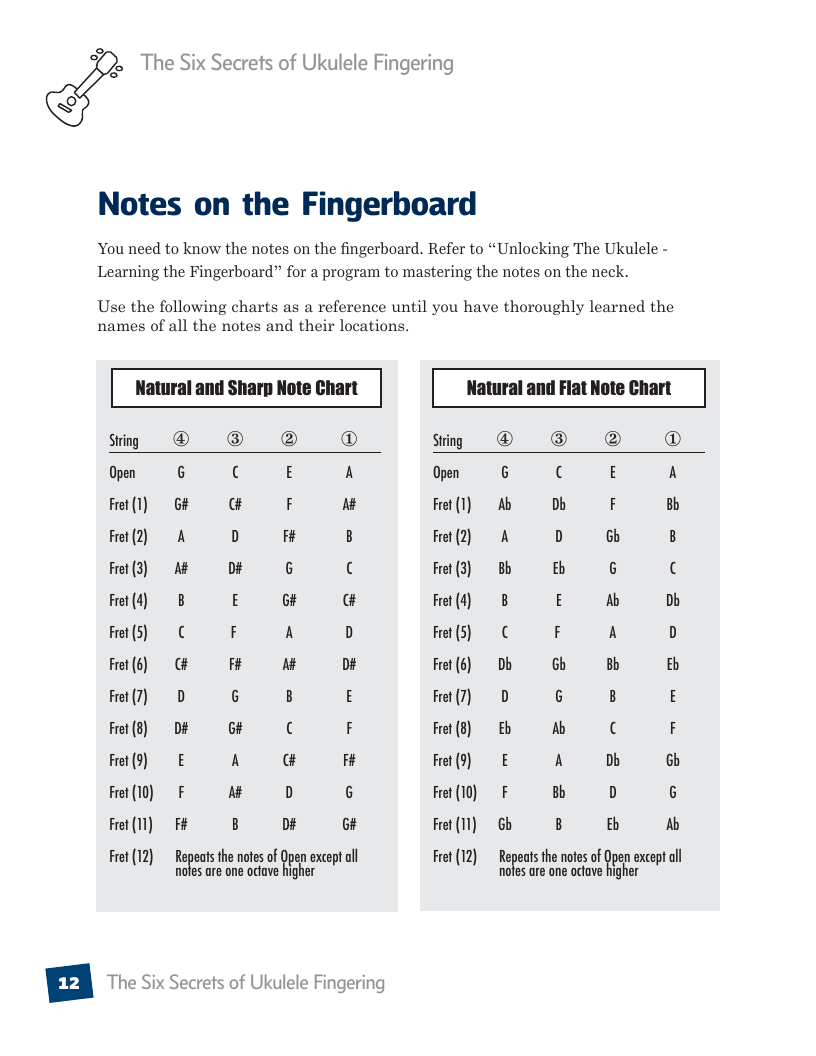
Notes on the Fingerboard 12
Motion Principles and their Applications 13
Stationary 14
Mobile 14
Summary of Fingering Principles 17
Basic Applications of the Motion Principles 18
Priority of Motion Principles 19
Motion Principles - the Details 19
Basic 19
Slide 19
Pass 20
Ascending Passes 20
Descending Passes 21
Contraction 23
Ascending Pitch Contractions 23
Descending Position Changes - Same String 23
Descending Pitch Contractions 24
Ascending Position Changes - Same String 24
Ascending Pitch Contractions 25
Descending Position Changes - Cross String 25
Descending Pitch Contractions 25
Ascending Position Changes - Cross String 25
Stretch 27
Leap 29
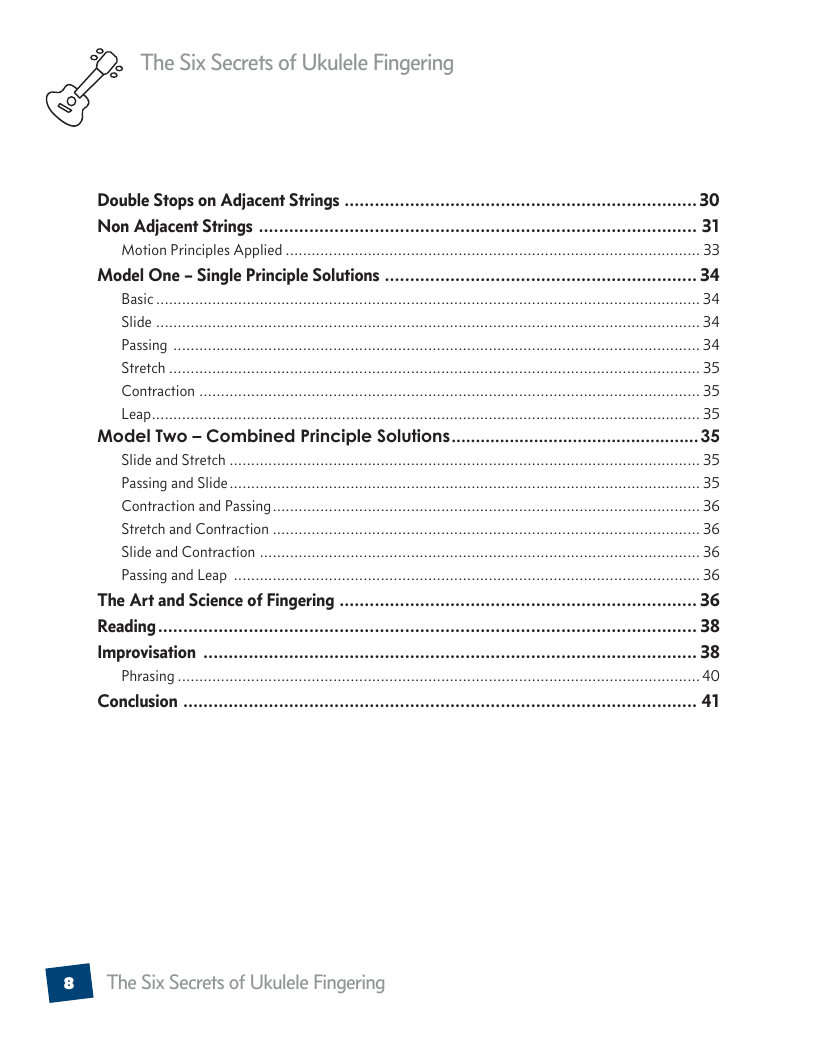
Double Stop Fingering 30
Double Stops on Adjacent Strings 30
Non Adjacent Strings 31
Motion Principles Applied 33
Model One - Single Principle Solutions 34
Basic 34
Slide 34
Passing 34
Stretch 35
Contraction 35
Leap 35
Model Two - Combined Principle Solutions 35
Slide and Stretch 35
Passing and Slide 35
Contraction and Passing 36
Stretch and Contraction.36
Slide and Contraction.36
Passing and Leap 36
The Art and Science of Fingering 36
Reading 38
Improvisation 38
Phrasing 40
Conclusion 41
Get The Latest Version
The current—latest PDF or e-book always has the latest changes and errata incorporated for the most up-to-date version of the file. If you downloaded the book from LearningUkulele.com
, you're most likely eligible to get the NEW
version of the book FREE
, or just let me know if you need the latest version.
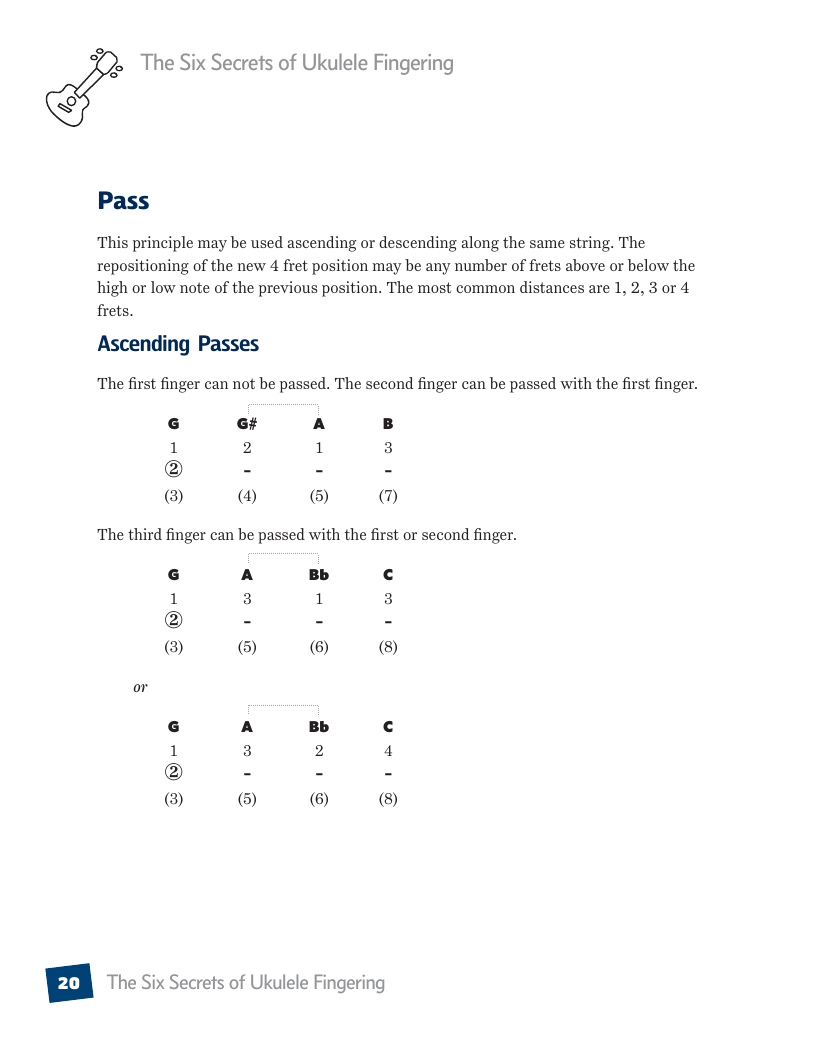
2024-12-04 — pg 20, the 1st Ascending Pass example notes should be
G G# A B
.
9 AUG 2021 — Book updated and corrections made. Fixed a bunch of the examples in the back part of the book. — OOPS!
21 JAN 2010 — Book updated and corrections made. Changes when made to a few of the examples.
17 OCT 2003 — Book Released and Errata Log File Created
Get The Latest Version
The current—latest PDF or e-book always has the latest changes and errata incorporated for the most up-to-date version of the file. If you downloaded the book from LearningUkulele.com
, you're most likely eligible to get the NEW
version of the book FREE
, or just let me know if you need the latest version.
Related Lessons
Related Lessons for Six Secrets of Ukulele Fingering.
Four Finger Slide Fingering Drills for Ukulele
Slide, used when the passage cannot be played within a single 4 fret span or when more notes per string required to produce a particular effect. I's also used in situations where a gradually ascending or descending diagonal motion best solves the physical and musical demands of the passage.
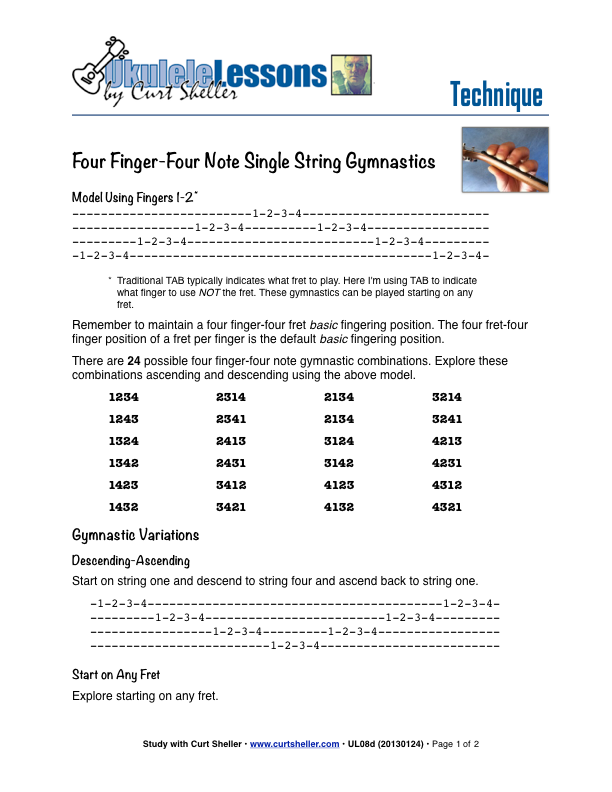
Four Finger-Four Note Basic Single String Fingering Drills for `Ukulele
To play the ukulele effectively, your fingers need physical strength, agility, flexibility and coordination. This four finger-four note drill is designed to get your hands in shape. These exercises work no matter what style of ukulele you play or want to play.
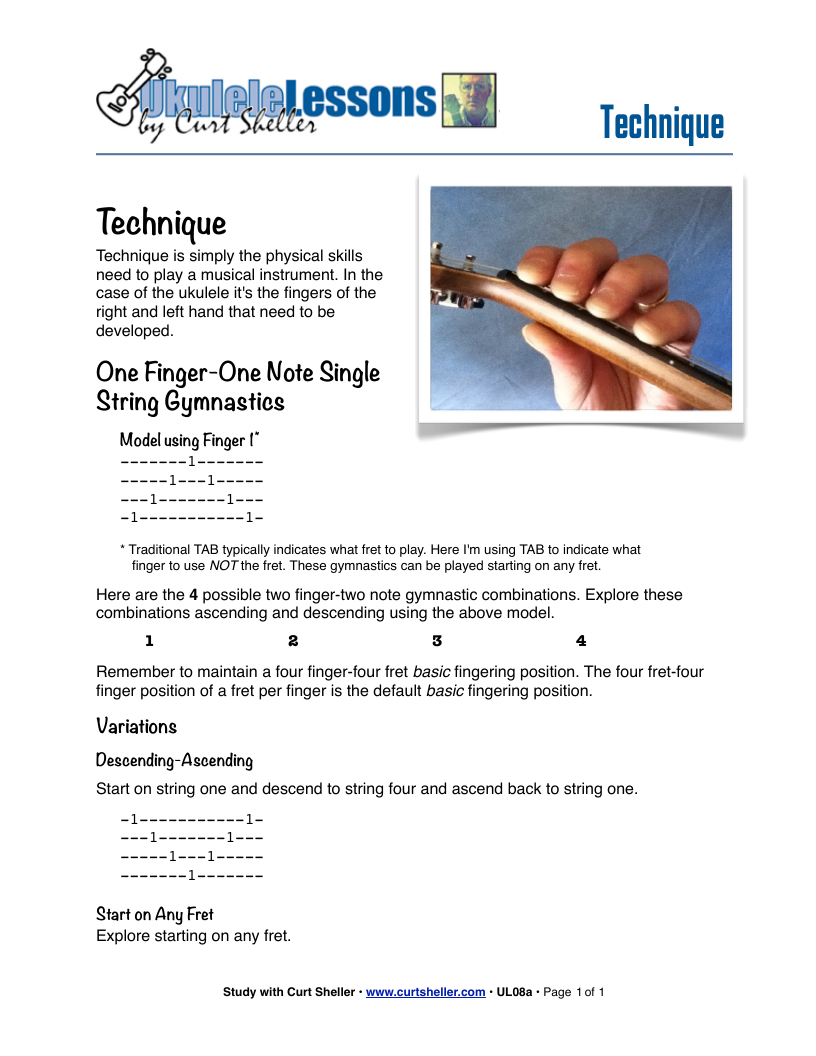
One Finger-One Note Basic Single String Fingering Drills for `Ukulele
To play the ukulele effectively, your fingers need physical strength, agility, flexibility and coordination. This one finger-one note drill is designed to get your fretting hand in shape.
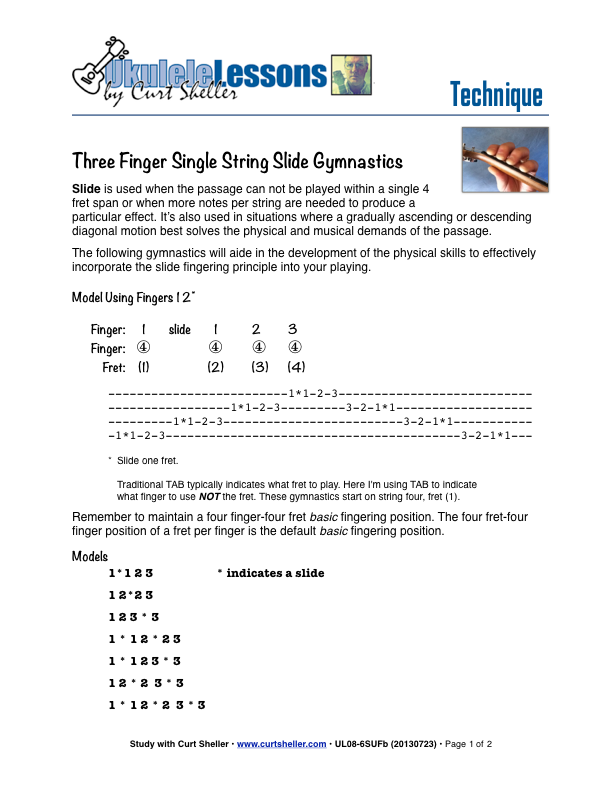
Three Finger Slide Fingering Drills for `Ukulele
Slide is used when the passage cannot be played within a single 4 fret span or when more notes per string required to produce a particular effect. I's also used in situations where a gradually ascending or descending diagonal motion best solves the physical and musical demands of the passage.
Three Finger-Three Note Basic Single String Fingering Drills for `Ukulele
To play the ukulele effectively, your fingers need physical strength, agility, flexibility and coordination. This three finger-three note drill is designed to get your fretting hand in shape.
Two Finger Pass Fingering Drills for `Ukulele
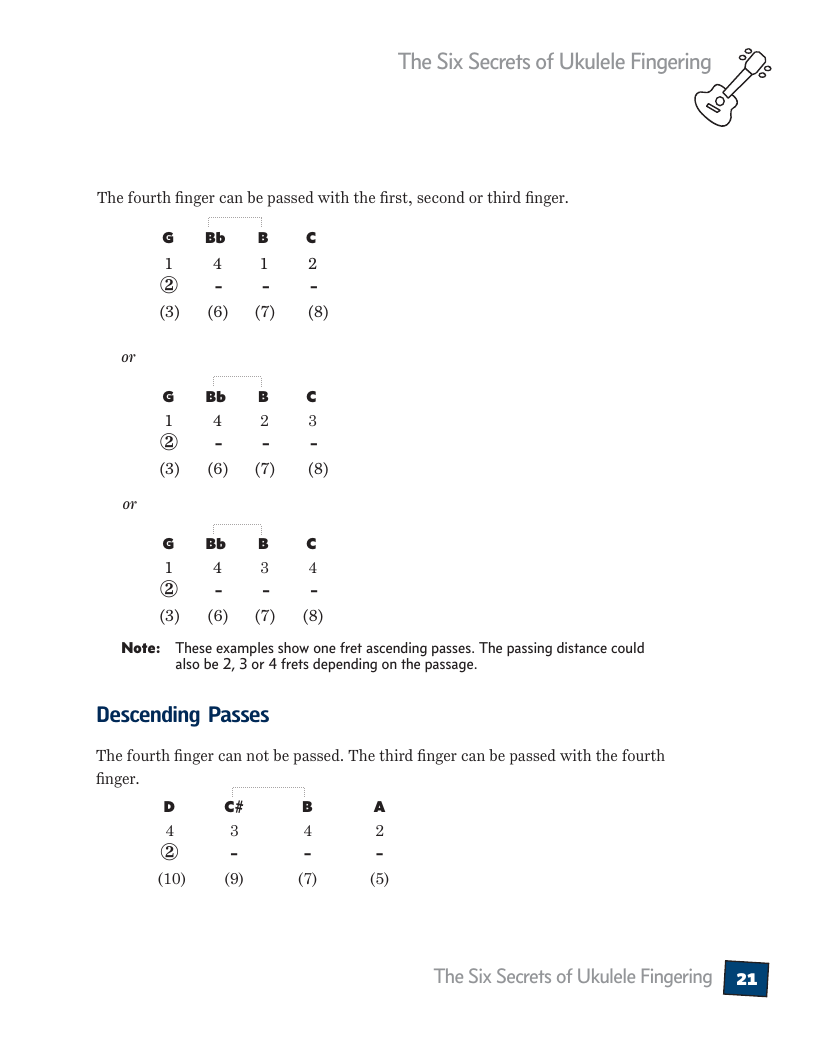
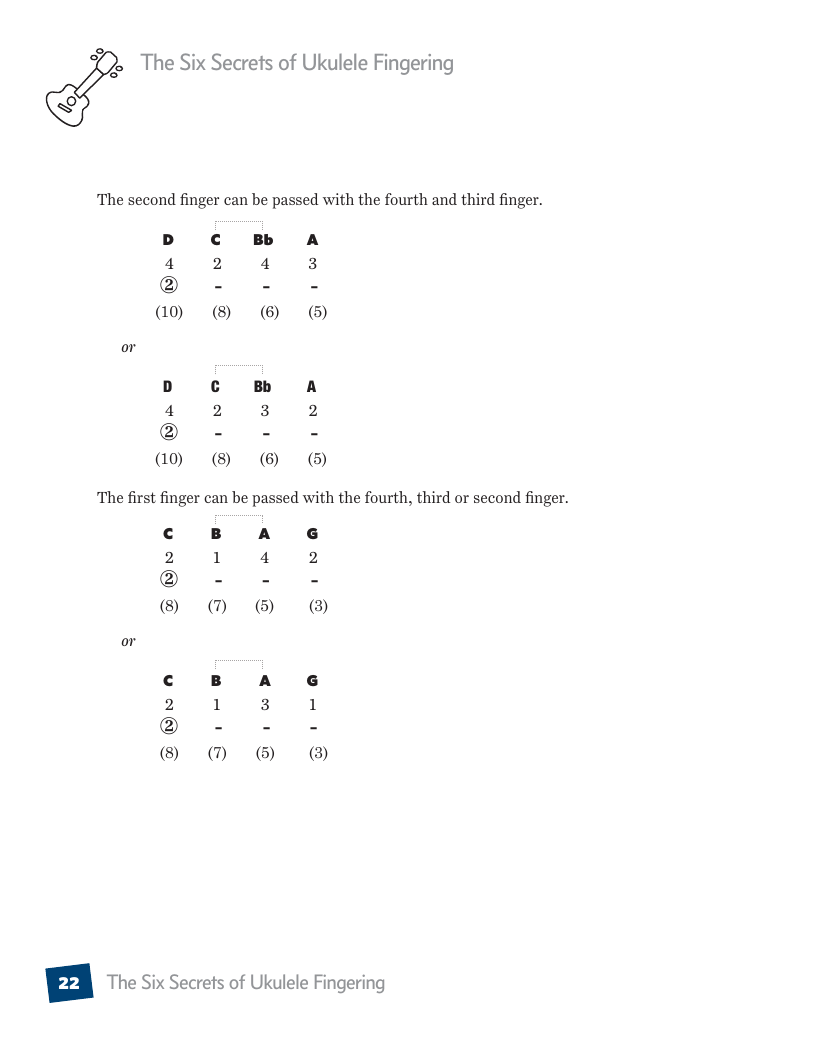
Pass maximizes the number of notes per string, making the timbre consistent. It's used to move up or down the neck to cope with a passage in which the range is unusually large. The pass provides an effective way to move straight up the first string. It's particularly useful in developing 3 octave fingerings and in playing melodies with an adjacent drone string.
Two Finger Slide Fingering Drills for `Ukulele
Slide is used when the passage cannot be played within a single 4 fret span or when more notes per string required to produce a particular effect. I's also used in situations where a gradually ascending or descending diagonal motion best solves the physical and musical demands of the passage.
Two Finger-Two Note Basic Single String Fingering Drills for `Ukulele
To play the ukulele effectively, your fingers need physical strength, agility, flexibility and coordination. This two finger-two note drill is designed to get your hands in shape. These exercises work no matter what style of ukulele you play or want to play.
What Finger is What?
Just what are the fingers of the plucking and fretting hand called. There can be a bit of confusion as to what the names and numbers of your fretting hand and the plucking or strumming hand are. Here are some of the common fingering notations I’ve encounter over the course of my studying ukulele and guitar.
Related Lesson Series
Related Lessons Series for Six Secrets of Ukulele Fingering.
Pass Gymnastics for Ukulele
Beyond the basic four fret fingering position, it's on to the remaining fingering principles for navigating the fingerboard. The second in the series is the Pass.
Slide Gymnastics for Ukulele
Beyond the basic four fret fingering position, it's on to the remaining fingering principles for navigating the fingerboard. The first in the series is the Slide.
Ukulele Fingering Gymnastics - Basic
This series of lessons develops your finger independence, strength and motor skills to a high level. You don't want to have technique as a limiting factor for play a song or performing anything on the ukulele.
An introduction to proper hand placement for left hand technique on ukulele and a wide variety of finger drills to develop your technique.
Ukulele Fingering Gymnastics - Repeating Notes
Repeating single note fingering drills for developing your ukulele technique.
Related Books & Charts
Related Books for Six Secrets of Ukulele Fingering.
QUICKSTART Scale and Arpeggio Series
The QUICKSTART — Scale and Arpeggio Fingerings Series is a concise, well-organized series of books, lessons, and workshops ideal for any guitar, ukulele, or bass player beginning to explore “improvisation”. Unlike so many other instructional materials on the market, The QUICKSTART — Scale and Arpeggio Fingerings Series keeps a sharp focus on the essential scales and arpeggios, their fingerings and their related chords. All material is covered in every key.
A Selection of Books & Reference Charts that are recommended for creating a solid foundation with your chosen instrument and music in general.
These are Books & Reference Charts that apply to a majority of the lessons on LearningUkulele.com—Learning Ukulele with Curt
.
Learn the six fingering principles to navigating the ukulele fingerboard. Fingering is one of the most universal topics. Book: Six Secrets of the Ukulele Fingering It there in one thing that give a ROI (corporate speak for return in your investment)—it is this— learning the f*cking notes of your OWN instrument. Sorry for the tough talks—but it is sooooo true!
Harmonic Analysis for Scale Selection and Chord Substitution
Daily Practice Material for the Contemporary Ukulele
An organized collection of daily practice and reference material for the contemporary ukulele player for developing the vocabulary and knowledge necessary for single note playing.
Book: Daily Practice Material for the Contemporary Ukulele
Related Songs for Six Secrets of Ukulele Fingering.
Any Song Will Do
This is not really a song, but simply saying that for the purposes of a lot of the lessons and lesson series on this site ANY song will do for exploring the lesson's material and concepts presented in the lesson.
Related Book Files, Resources and Assets
Related Assets for Six Secrets of Ukulele Fingering.
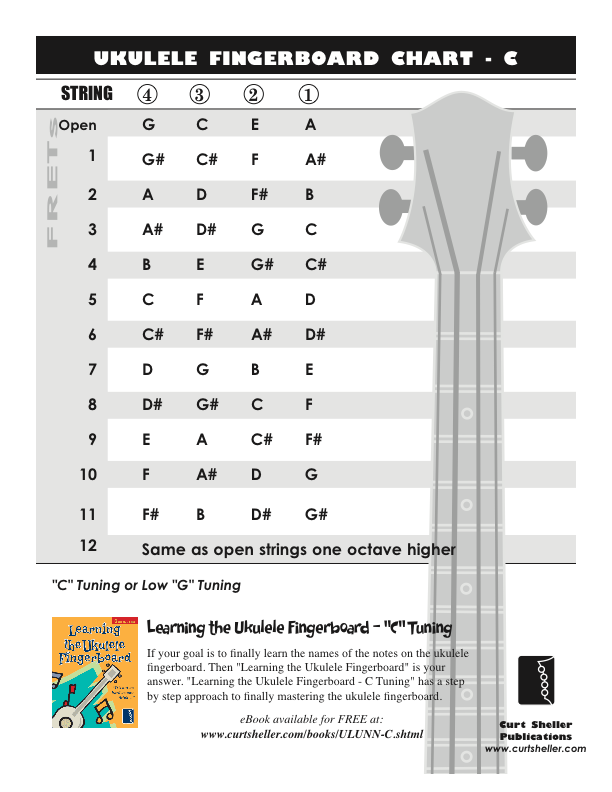
Ukulele Fingerboard Chart for C Tuning, Low or High G
Ukulele Fingerboard Chart for C Tuning, Low or High G. Shows natural, sharp and flat notes for the ukulele fingerboard. This tuning can be used on a soprano, concert, tenor and baritone ukuleles.
Ukulele Fingerboard Chart for D Tuning, Low or High A
Ukulele Fingerboard Chart for D Tuning, Low or High DG. Shows natural, sharp and flat notes for the ukulele fingerboard. This tuning can be used on a soprano, concert or tenor ukulele.
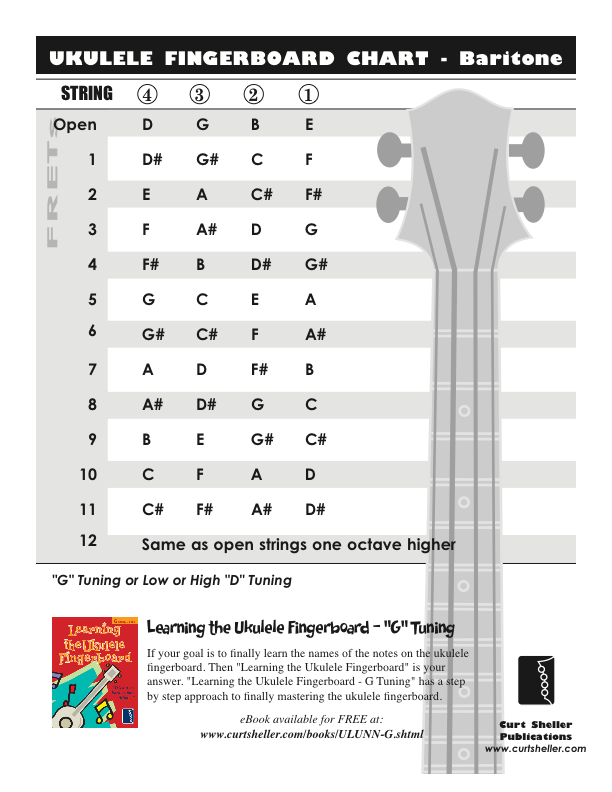
Ukulele Fingerboard Chart for G Tuning, Low or High D
Ukulele Fingerboard Chart for G Tuning, Low or High D. Shows natural, sharp and flat notes for the ukulele fingerboard. This tuning can be used on a baritone or tenor ukulele.
Six Secrets of Ukulele Fingering - Arpeggio Plus One Worksheet Example
Arpeggio fingering chart exploring different pathways through a 1 2 3 5 major arpeggios. This is the Trial Plus One lessons series.
Six Secrets of Ukulele Fingering - Arpeggio Worksheet
Arpeggio fingering chart worksheet for exploring multiple and alternate pathways through an arpeggio.
Six Secrets of Ukulele Fingering - Interval Worksheet
Scale interval fingering chart worksheet for exploring multiple and alternate pathways through scale intervals.
Six Secrets of Ukulele Fingering - Scale Worksheet
Scale fingering chart worksheet for exploring multiple and alternate pathways through a scale.
Six Secrets of Ukulele Fingering - Scale Worksheet Example
Six Secrets of Ukulele Fingering - Sequence Worksheet
Scale sequence fingering chart worksheet for exploring multiple and alternate pathways through a scale sequence.