From tuning by ear to using an electronic tuner. The lesson goes over the various tuning methods for tuning your ukulele. You ALWAYS need to play in tune.
From tuning by ear to using an electronic tuner. The lesson goes over the various tuning methods for tuning your ukulele. You ALWAYS need to play in tune.
Video Available for Premium Site Members Only
This Video is NOT part of your LearningUkulele.com Site Access level. Sign-up for Premium Site Access or Upgrade your current access level to view this video. Sorry can't continue to justify giving so much away for FREE. For FREE videos hit up YouTube.
Basically just BUY an electronic tuner and use it or use an app on your phone. However, also learn to tune your ukulele to itself when no external tuning reference is available, or, you just don't have you tuner around. Both valuable skills to learn. No excuse for being out of tune in the day an age.
This is tuning by using a reference note and comparing each string to this note. A tuning fork , piano or other instrument can be used as the reference note.
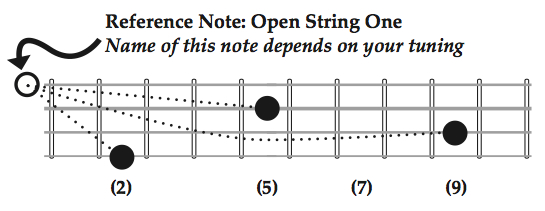
Using the open string as your reference note, in the case of "C" tuning, an A note and using an A440Hz tuning fork or other instrument. Tune the open string one to this reference note. Adjust the string higher or lower to match the reference note. I listen for any wobble or oscillation between the pitches and tune until this goes away. If I get lost and I'm not sure if I'm too sharp or flat, higher or lower in pitch to the reference note. I loosen the string until I know it is flat, or lower in pitch and start over.
The Ukulele strings are, from nose–to–toes: ④ ② ③ ①
Compare string ② fret (5) to string ① open. These are the exact same note and pitches.
Now this is where most people make an error in tuning. They then compare string three to two. If you didn't tune string two just right, any errors will be introduced to string three.
Compare string ③ fret (9) to string ① open. This is the same note.
String one might even vibrate on its oven when you play the note on string three
if it is already the same pitch.
Compare string ④ fret (2) to string ① open. If using a high "G" tuning this is the same note. If using a low "G" tuning, this note is one octave lower and still a pure interval.
NOTE: We are only comparing pure intervals: unison and octaves. No harmonics or other intervals.
A little "TMI" on tunings
Musical Intervals, Frequency, and Ratio
In order to really understand tuning, the harmonic series, intervals, and harmonic relationships, it is very useful to understand a little bit about the physics of sound and to be comfortable discussing ratios, fractions, and decimals. This lesson is a short review of some basic math concepts for students who want to understand some of the math and physics principles that underlie music theory.
Tuning Systems
Here are two tuning systems, names that you might encounter in you travels in ukulele circles.
The Pythagorean System
Pythagorean tuning is a system of musical tuning in which the frequency relationships of all intervals are based on the ratio 3:2. Its name comes from medieval texts which attribute its discovery to Pythagoras, but its use has been documented as long ago as 3500 B.C. in Babylonian texts. It is the oldest way of tuning the 12-note chromatic scale. ( source
(wikiwand)
)
Equal Temperament
In musical tuning, a temperament is a system of tuning which slightly compromises the pure intervals of just intonation in order to meet other requirements of the system.( source
(wikiwand)
)
Equal Temperament IS the tuning system that we use in western music.
The Problem with Tuning Using Harmonics
The music we play and listen to, which is based on the 12-tone scale, uses equal temperament tuning (see Equal Temperament above).
A Harmonic, a pure interval. Equal Temperament tuning does not use pure intervals. As such, the ukulele, which uses the Equal Temperament tunings, is not tuned using pure intervals. So unless you are comparing the same pitches or octaves, the only pure intervals — you WILL get tuning errors.
You can use harmonics to get close then use the pure intervals, the octaves and unison notes for final tweaking.
Relative Tuning
If you have a good Relative Pitch and can recognized melodic intervals. You can tune your ukulele by comparing one note to another. Using the open strings the comparison intervals are:
High G - C Tuning (gCEA) and High A - D Tuning (aDF#B)
Compare string ② to string ①, a perfect fourth
Compare string ③ to string ②, a major third
Compare string ④ to string ①, major second
Low G – C Tuning (GCEA), Low A – D Tuning (ADF#B), and G tuning (DGBE)
Compare string ② to string ①, a perfect fourth
Compare string ③ to string ②, a major third
Compare string ④ to string ③, perfect fourth
Note:: The Low G tuning is the same relative intervals as the thin four strings of the guitar.
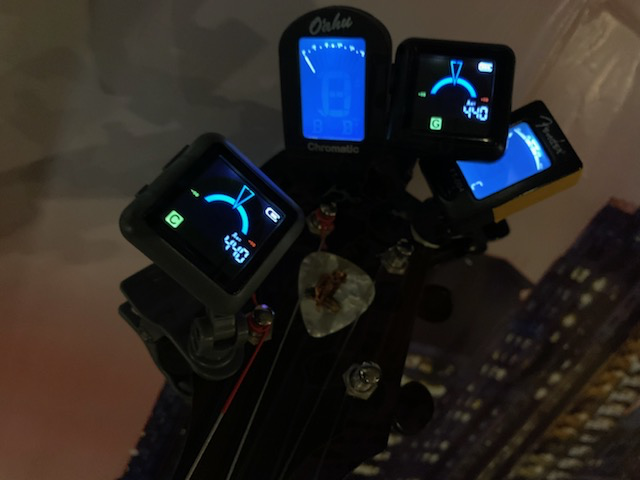
There are a lot of electronic tuners available that can be used for tuning your ukulele. There are foot pedals, clip-one tuners, LED tuners, built-in instrument tuners, and strobe tuners. Visit the LearningUkulele.com page on Electronic Tuners for listings of manufactures and information on these types of tuners.
I recommend getting a chromatic tuner that can tune a string to anyone of the 12 notes of the chromatic scale.
A A# B C C# D D# E F F# G G#
.
A440?
Just what is A440? A440 is the standard pitch reference where the musical note A above middle C vibrates at exactly 440 Hz (cycles per second). This serves as the universal tuning standard for most Western music.
For ukulele specifically, A440 matters because it's the reference point for tuning all four strings to their correct pitches. When you tune a ukulele in standard tuning (G-C-E-A from top to bottom), that high A string should match A440. The other strings are then tuned relative to this standard:
High G, C Tuning
The
A
string (4th/ closest to your toes) = 440 Hz
The
E
string (3rd string) = 329.63
The
C
string (2nd string) = 261.63 Hz
The
G
string (1st/top string) = 392 Hz
When you use an electronic tuner or tuning app, it's calibrated to A440 by default. This ensures that when you play with other instruments or musicians who are also tuned to A440, everything sounds harmonious together.
Some musicians occasionally tune to A441, A442, or other variations for specific ensemble or tonal reasons, but A440 has been the international standard since 1939.
A reason to tune the something hiigher or lower than A440 is when you might have to tune to a piano or an instrument that can not re-tune easily.
Sign-IN, for free — to View, Un-Blur Any Additional Content for This Lesson—Can't give it ALL away.
End of Lesson - Thanks, Hope You Enjoyed It!
Related Lessons, Videos, Lesson Series, Songs, Books & Reference Charts, Resources & Assets, Workshops are below.
Related Lessons
Related Lessons for Tuning Your Ukulele.
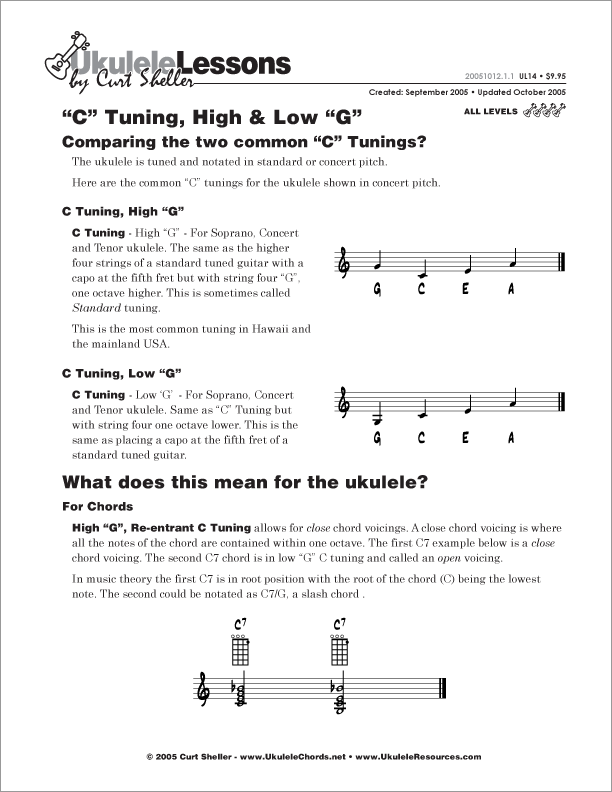
Comparing the High G and Low G, C Tunings
Exploring the differences in these two common C tunings, both the high G reentrant tuning associated with he ukulele and the low G variation. There are benefits to exploring both C tunings. Good excuse to have more ukes -:)
Related Lesson Series
Related Lessons Series for Tuning Your Ukulele.
Common Ukulele Tunings
Any tuning is possible on a ukulele as long as the construction supports it and a string is available. There are three somewhat common tunings in popular use today, C, D and G tuning - with C tuning the most popular.
Related Books & Charts
Related Books for Tuning Your Ukulele.
Learning the Ukulele Fingerboard - C Tuning
Finally, learn the names of the notes of the fingerboard. Learning the notes of your instrument allows you the flexibility of not having to remember so many shapes. There are simply way too many chords, scale and notes patterns, and shapes to remember. It all comes down the notes.
Learning the Ukulele Fingerboard - D Tuning
If your goal is to finally learn the names of the notes on the ukulele fingerboard. Then Learning the Ukulele Fingerboard - D Tuning is your answer. Learning the Ukulele Fingerboard - D Tuning, has a step by step approach to finally mastering the ukulele fingerboard.
Learning the Ukulele Fingerboard - G Tuning
If your goal is to finally learn the names of the notes on the ukulele fingerboard. Then Learning the Ukulele Fingerboard - G Tuning is your answer. Learning the Ukulele Fingerboard - G Tuning, has a step by step approach to finally mastering the ukulele fingerboard.
A Selection of Books & Reference Charts that are recommended for creating a solid foundation with your chosen instrument and music in general.
These are Books & Reference Charts that apply to a majority of the lessons on LearningUkulele.com—Learning Ukulele with Curt
.
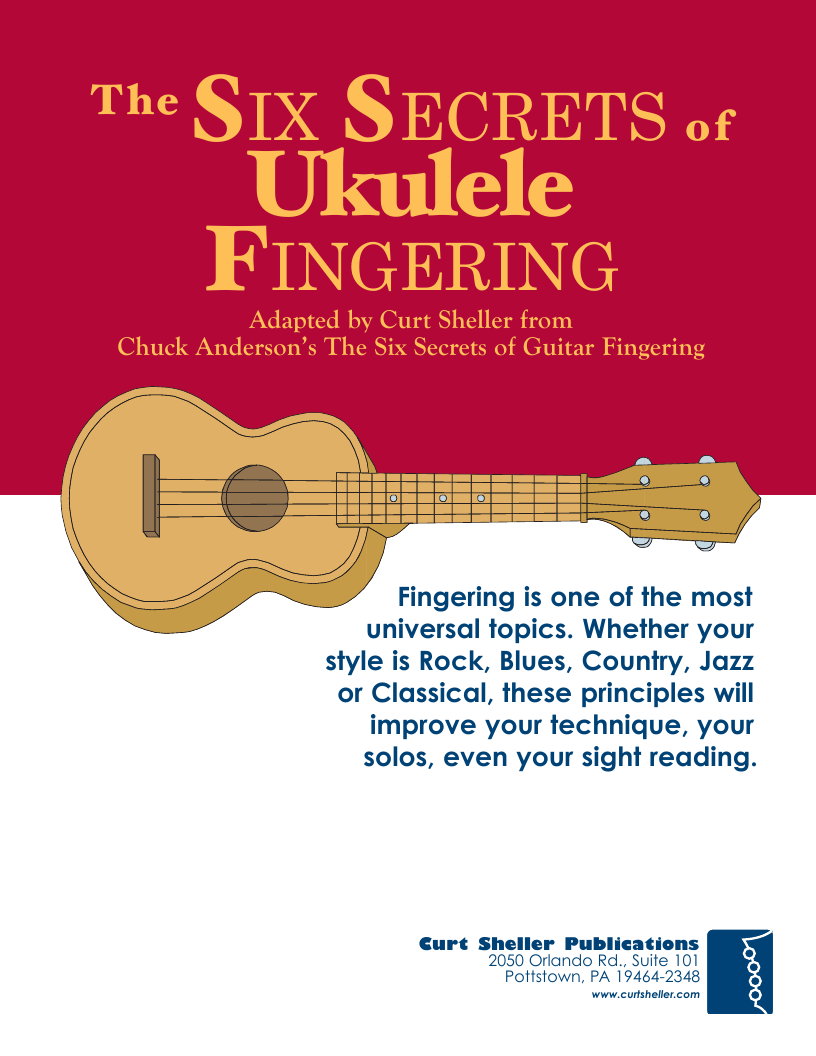
Learn the six fingering principles to navigating the ukulele fingerboard. Fingering is one of the most universal topics. Book: Six Secrets of the Ukulele Fingering It there in one thing that give a ROI (corporate speak for return in your investment)—it is this— learning the f*cking notes of your OWN instrument. Sorry for the tough talks—but it is sooooo true!
Harmonic Analysis for Scale Selection and Chord Substitution
Daily Practice Material for the Contemporary Ukulele
An organized collection of daily practice and reference material for the contemporary ukulele player for developing the vocabulary and knowledge necessary for single note playing.
Book: Daily Practice Material for the Contemporary Ukulele
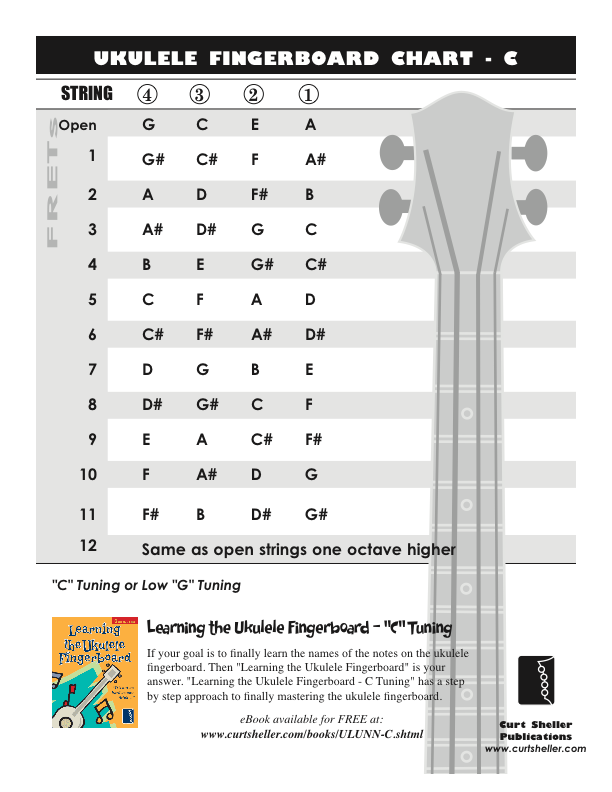
Ukulele Fingerboard Chart for C Tuning, Low or High G
Ukulele Fingerboard Chart for C Tuning, Low or High G. Shows natural, sharp and flat notes for the ukulele fingerboard. This tuning can be used on a soprano, concert, tenor and baritone ukuleles.
Ukulele Fingerboard Chart for D Tuning, Low or High A
Ukulele Fingerboard Chart for D Tuning, Low or High DG. Shows natural, sharp and flat notes for the ukulele fingerboard. This tuning can be used on a soprano, concert or tenor ukulele.
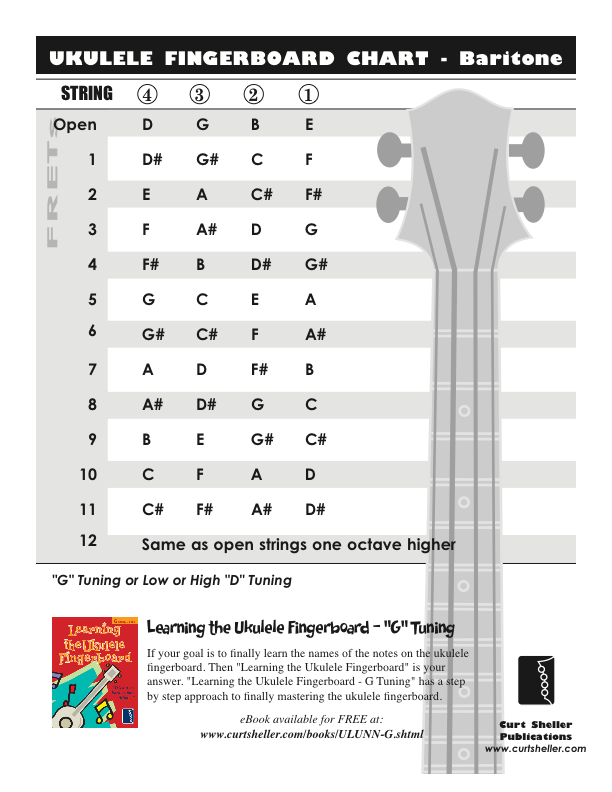
Ukulele Fingerboard Chart for G Tuning, Low or High D
Ukulele Fingerboard Chart for G Tuning, Low or High D. Shows natural, sharp and flat notes for the ukulele fingerboard. This tuning can be used on a baritone or tenor ukulele.




 This is tuning by using a reference note and comparing each string to this note. A tuning fork , piano or other instrument can be used as the reference note.