Learning Ukulele with Curt
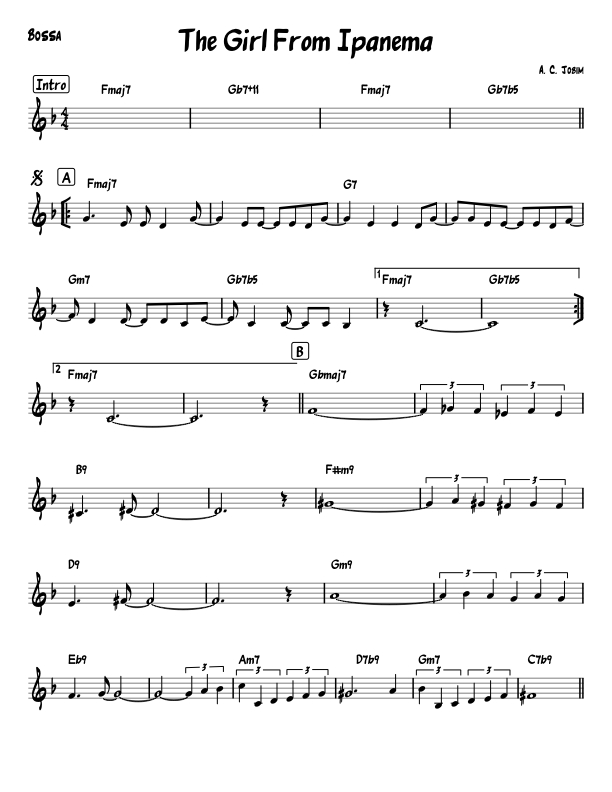
The Girl From Ipanema

Harmonic Analysis (RMA) Worksheet for the song: "The Girl From Ipanema".


Publisher: N/A Authors(s): N/A
Category: Harmonic-Analysis Instrument: Any Subjects(s): TheoryProgressionsLatinBossaHarmonyAnalysisRMAJobim
Premium Member Feature
Share the The Girl From Ipanema on: Bluesky facebook twitter (X)
The Girl From Ipanema

Harmonic Analysis (RMA) Worksheet for the song: The Girl From Ipanema.
The Girl From Ipanema

Garota de Ipanema (The Girl From Ipanema) is a Brazilian bossa nova and jazz song. It was a worldwide hit in the mid-1960s and won a Grammy for Record of the Year in 1965. It was written in 1962, with music by Antônio Carlos Jobim and Portuguese lyrics by Vinícius de Moraes. English lyrics were written later by Norman Gimbel.

The first commercial recording was in 1962, by Pery Ribeiro. The Stan Getz recording featuring the vocal debut of Astrud Gilberto became an international hit. This version had been shortened from the version on the album Getz/Gilberto (recorded in March 1963, released in March 1964), which had also included the Portuguese lyrics sung by Astrud's then husband João Gilberto. In the US, the single peaked at number five on the Billboard Hot 100, and went to number one for two weeks on the Easy Listening chart. Overseas it peaked at number 29 in the United Kingdom, and charted highly throughout the world.

Numerous recordings have been used in films, sometimes as an elevator music cliché. It is believed to be the second most recorded pop song in history, after "Yesterday" by The Beatles. The song was inducted into the Latin Grammy Hall of Fame in 2001. In 2004, it was one of 50 recordings chosen that year by the Library of Congress to be added to the National Recording Registry. (wikiwand)

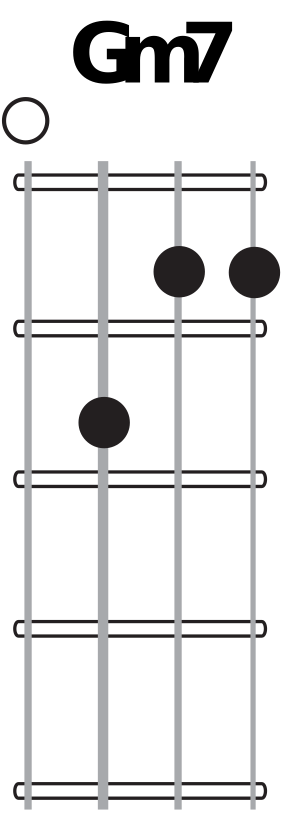
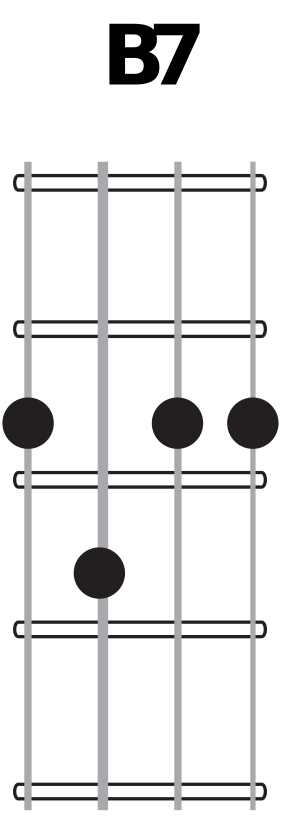
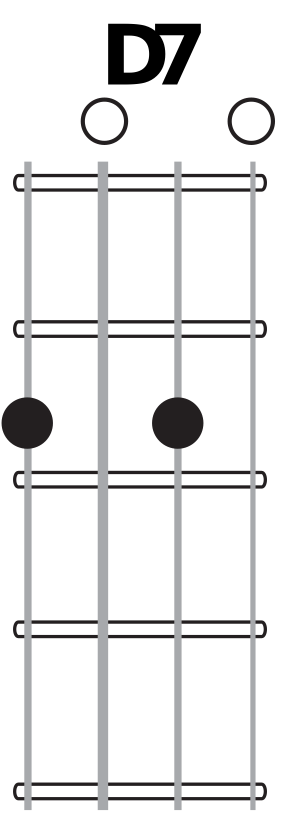
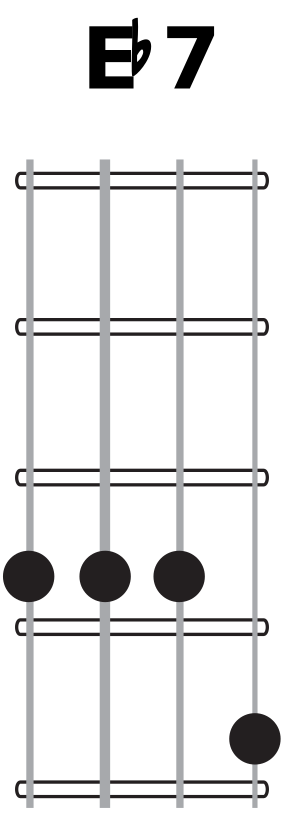
Ukulele Chords
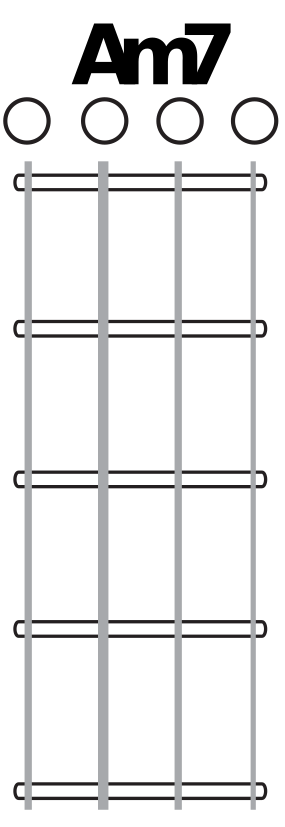
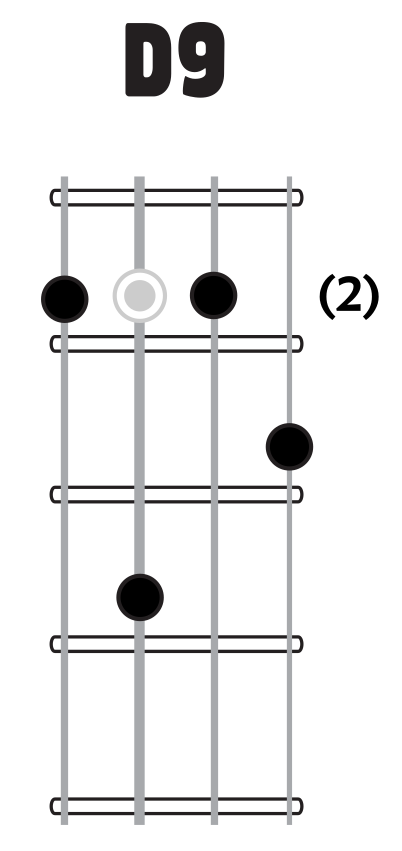
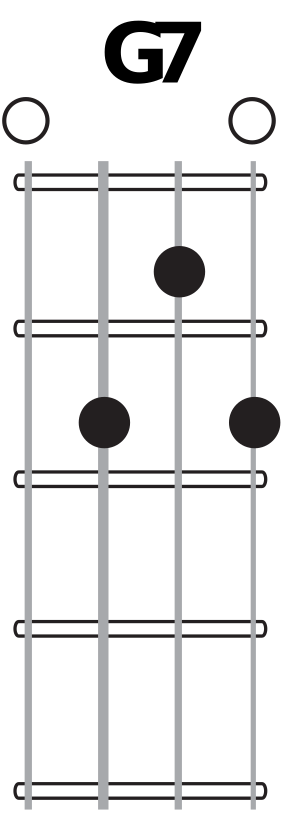
Fma7 G7 Gm7 Gb7 Gbma7 B7 F#m7 D7 Eb7 D7 Am7 D7b9 C7b9
Theses and many other chords are covered in the Learn A Chord A Day series of lessons.
C Tuning Chords
Starting Melody Note and 1st Interval
  • The Girl From Ipanema is in 4/4, Common Time and the Key of F .
  • Start on M2 ↓ m3.
  • Intervals Legend: Root=note that begins a scale of the starting key; C is C, D is D, Am is A, Em is E, etc… m=minor; M=Major; P=Perfect; D=Diminished; A=Augmented. • is up/ascending; is down/descending;
    Harmonic Analysis (HA) Worksheet
    Visit the Harmonic Analysis for Scale and Chord Selection series of lessons for information on creating a your own Harmonic Analysis Worksheet
    A re-harmonization, in Red can be a simple, sticking pretty close to the original composer's intentions or complex and a whole new set of chord changes.

    RMA Worksheet Coming Soon

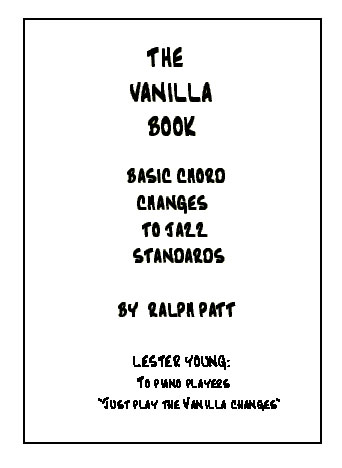
    Ralph Patt Vanilla Book
    Checkout the Ralph Patt Vanilla Book Vanilla changes for The Girl From Ipanema • The Vanilla Book uncovers the basic ("Vanilla") chord changes to over 400 of the most commonly played jazz standards to help the jazz player learn the basic changes and allow the player to add embellishments and substitutions on a solid framework.

    Embellishments to basic chords such as added 6ths, 9ths, 13ths, flat 5ths etc. are usually determined by the melody notes and the style of music being played.

    The Harmonic Analysis (HA)
    A Harmonic Analysis (RMA/HA) and its worksheet are intended to show the function of the chords, the harmonic principles used, the keys and tonalities the song explores. And, can be used for scale selections and chord and scale substitutions.
    NOTE: A Harmonic Analysis Worksheet is NOT intended to be a lead leadsheet. Minimal roadmap information such as repeats, fine, D.S., D.C., and codas has been used in preparing the worksheets to somewhat mirror the leadsheet in the Daily Ukulele book.
    Sections, Verse, Chorus, 1st, 2nd Ending, turnbacks …
    The worksheets will show 1st, 2nd Ending, turnbacks, etc. as in indicated the Yellow Book. You should start to recognize that 1st endings typically always return to a previous verse or an section. With a 2nd ending, a transition to a different part of the song, a or chorus. Harmonic Principles are used for these repeats and transitions.


    If turnback chords are not indicated for the these 1st and 2nd endings in the original Yellow Book leadsheet recommended chord(s) will indicated in parentheses or as an alternate harmony in Red . Typically the last measures or turnbacks will be a chord that resolves to and harmonically leads you to the next section or turning you back to the same section. Typically a V or direct substitution of that next chord.
    Reference Key
    This is the key of the source leadsheet.
    • The Girl From Ipanema is in 4/4, Common Time and the Key of F .
    Harmonic Principles Used:
    These are the harmonic principles used in The Girl From Ipanema.
    Nashville Number System (NNS)
    Nashville Numbering System always uses four bars/measures per line, no bar lines, and default is each number of the number of beats per bar/measure based on the time signature. If multiple chords in same bar then they are underlined. It can be as simple as convert the Roman Numerals above to Arabic number.
    At its simplest you simply replace the roman numbers with Arabic numbers. e.g., I becomes 1 , II becomes 2 , etc. The only exception is the bVII7 chord becomes 7 as this borrowed chord from the Mixolydian tonality is so common and the VII (half-diminished seventh) in a major chord is so rare (actually never). And, you could go as far as saying all the modes are numbered: I II II IV V VI VII — just as in the major scale. So calling it a 7 is not that far out.
    Check the definitive book Nashville Number System
    Scale Selection
    Once a Harmonic Analysis has been completed, scale selections can be made. These scale selections can be either vertical or horizontal choices. And, really, only needed if you are going to take a solo or embellish the melody with added notes.
    Scale Abbreviation Legend
    Traditional Scales: Maj: Major (Ionian), Dim: Diminished, WT: Whole Tone, Har Min: Harmonic Minor,
    Contemporary Scales: Minor Pent: Minor Pentatonic, Pent: Major Pentatonic, Blues,
    Scale/Mode Names: Ion: Ionian (Major), Dor: Dorian (Minor), Phrygian: Phrygian, Lyd: Lydian, Mix: Mixolydian (Dominant), Aeol: Aeolian (Natural Minor), Loc: Locrian
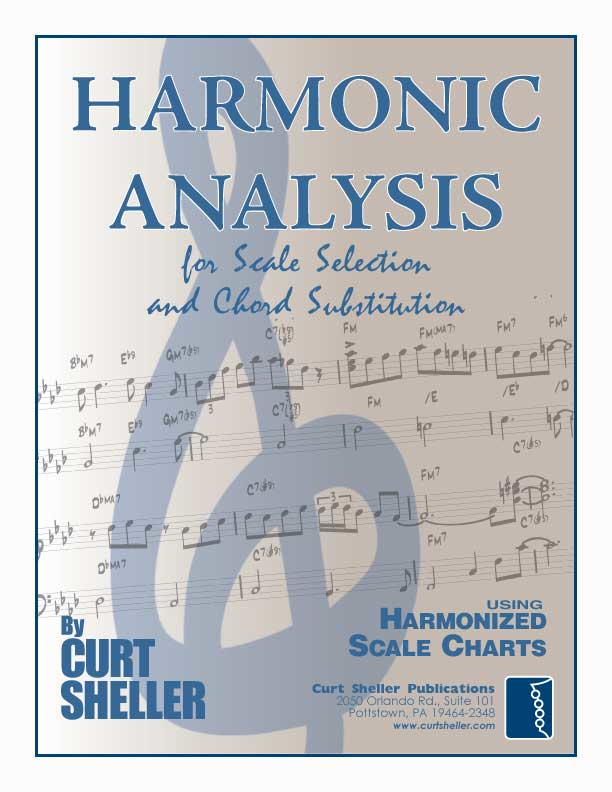
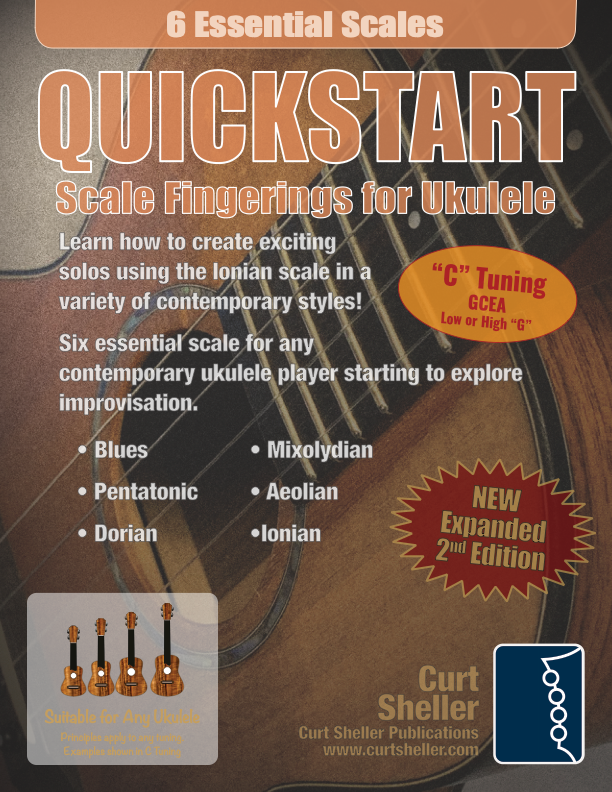
    RMA book cover QS1UKES book cover
    Performance Notes
    Links & Resources
    Sign-IN, for free — to View, Un-Blur Any Additional Content for This Lesson—Can't give it ALL away.
    art by Curt Sheller
    End of Lesson - Thanks, Hope You Enjoyed It!

    Related Lessons, Videos, Lesson Series, Songs, Books & Reference Charts, Resources & Assets, Workshops are below.

    Related Lesson Series
    Related Lessons Series for The Girl From Ipanema.
    Harmonic Analysis for Scale and Chord Selection

    Harmonic Analysis (HA), also known as the study of chord relationships, is the method used to identify the harmonic role of chords within a chord progression or song. A chord progression refers to a sequence of chords, with each chord having a root note and belonging to a specific chord type. The function of a chord within a particular scale's tonality is determined by its relationship to that scale.
    Related Songs
    Related Songs for The Girl From Ipanema.
    UL434
    Girl From Ipanema

    The Girl from Ipanema (Garota de Ipanema) is an essential jazz standard that every jazz musician should know. The A sections chord progression, basically a I II7 II V is functionally the same as Take the A Train, Jersey Bounce, Desafinado and a few others.

    Related Books & Charts
    Related Books for The Girl From Ipanema.
    RMA1
    Harmonic Analysis for Scale Selection and Chord Substitution

    Harmonic Analysis is the understanding of the functional sequence of chords. It is the process used to analyze the harmonic structure of a progression, song or composition. This analysis is then used to make scale selections for improvisation and chord substitution.
    HL00312097
    How to Play from a Real Book

    All musicians should be able to sit down at the keyboard and make sense of a tune. With that goal in mind, every instrumentalist and singer can profit from this book. It covers many techniques for exploring, understanding, and performing the songs found in real books.

    HL00240221
    The Real Book – Volume I – Sixth Edition

    The Real Books are the best-selling jazz books of all time. Since the 1970s, musicians have trusted these volumes to get them through every gig, night after night. The problem is that the books were illegally produced and distributed, without any regard to copyright law, or royalties paid to the composers who created these musical masterpieces.


    A Selection of Books & Reference Charts that are recommended for creating a solid foundation with your chosen instrument and music in general.
    These are Books & Reference Charts that apply to a majority of the lessons on LearningUkulele.com–Learning Ukulele with Curt .
    Learning the Ukulele Fingerboard – C Tuning
    Finally, learn the names of the notes of the ukulele fingerboard in C tuning .
    Six Secrets of the Ukulele Fingering
    Learn the six fingering principles to navigating the ukulele fingerboard. Fingering is one of the most universal topics. Book: Six Secrets of the Ukulele Fingering It there in one thing that give a ROI (corporate speak for return in your investment)—it is this— learning the f*cking notes of your OWN instrument. Sorry for the tough talks—but it is sooooo true!
    Harmonic Analysis for Scale Selection and Chord Substitution
    Harmonic Analysis is the understanding of the functional sequence of chords. It is the process used to analyze the harmonic structure of a progression, song or composition. Book: Harmonic Analysis for Scale Selection and Chord Substitution
    Ukulele – Reading Music Series – Primer

    Learn to read single note melodies in the first/open position is a lot easier than you might think. Book: Ukulele – Reading Music Series – Primer
    Daily Practice Material for the Contemporary Ukulele

    An organized collection of daily practice and reference material for the contemporary ukulele player for developing the vocabulary and knowledge necessary for single note playing. Book: Daily Practice Material for the Contemporary Ukulele

    Checkout the Books & Reference Charts for additional Handy, Dandy Reference Charts.
    Reference Charts
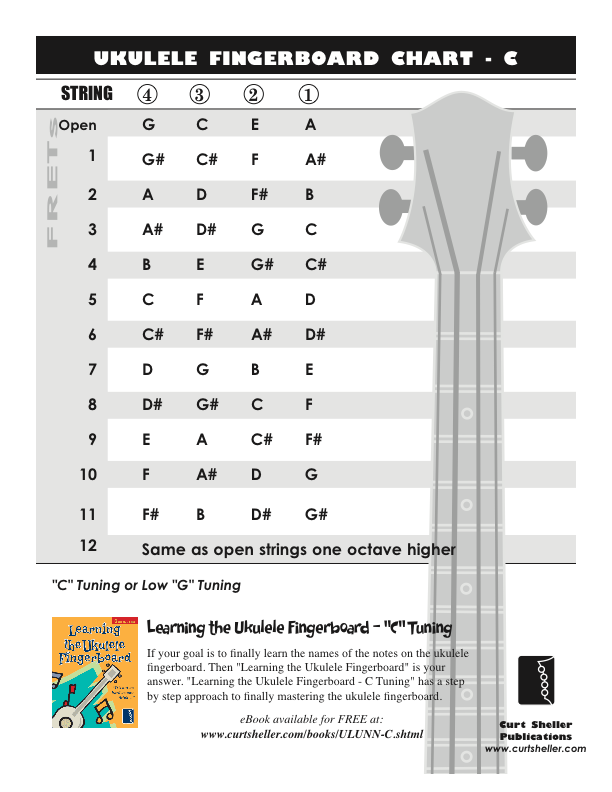
    Ukulele Fingerboard Chart for C Tuning, Low or High G - G C E A

    Ukulele Fingerboard Chart for C Tuning, Low or High G – G C E A
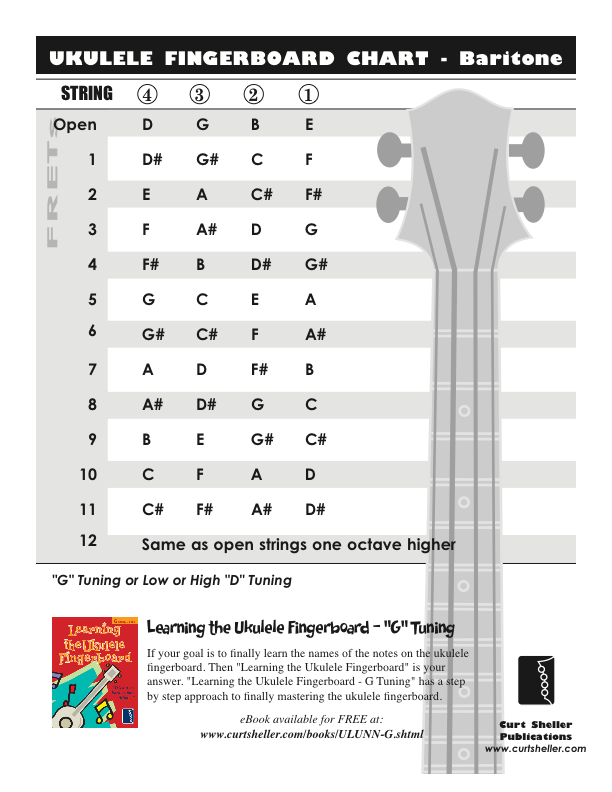
    Ukulele Fingerboard Chart for G Tuning, Low or High A – D G B E
    Ukulele Fingerboard Chart for G Tuning, Low or High A – D G B E

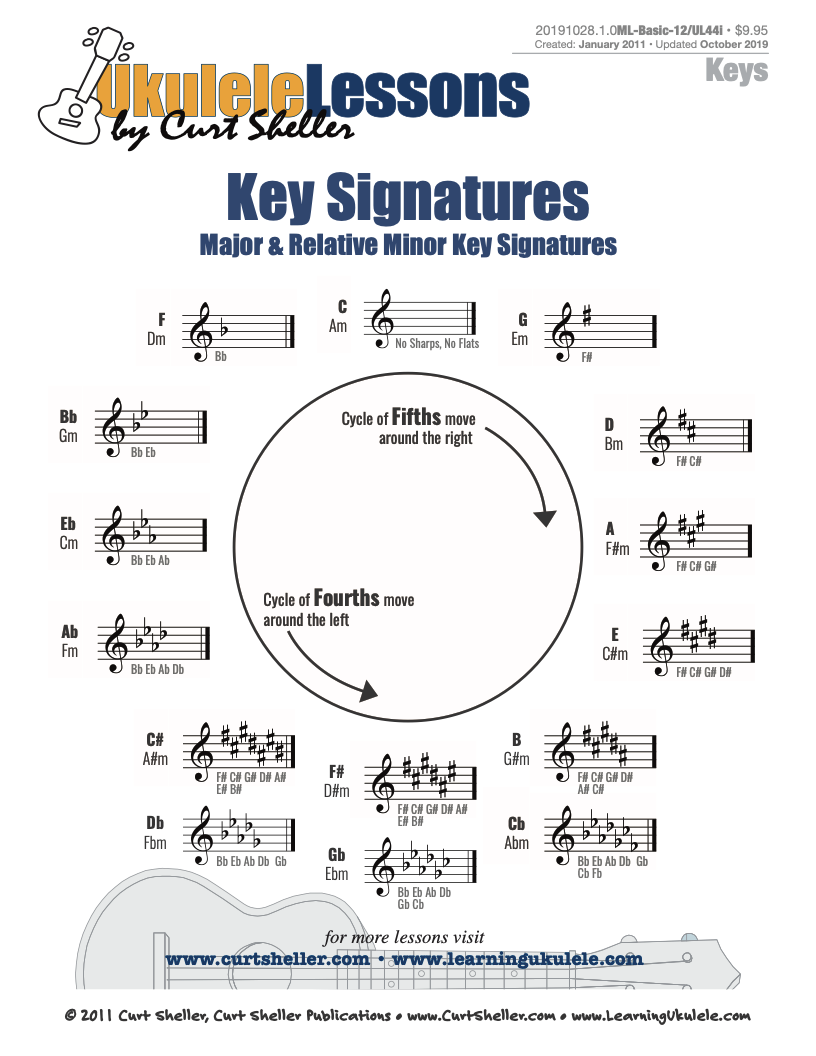
    Circle of Fourths and Fifths – ANSI A & A4 sizes

    A handy reference chart of all 15 major and relative minor key signatures. US Letter 8.5 x 11 sized (ANSI-A) , A4

    Checkout the Books & Reference Charts for additional Handy, Dandy Reference Charts.
    🚀 🚧 End of LearningUkulele.com Site Content 🚧 🌍
    NOTE: PICS ARE FROM VARIOUS SOURCES. FAIR USE NOTICE:: This site contains images of which have not been pre-authorized. This material is made available for the purpose of analysis, teaching, comment and critique. The 'fair use' of such material is provided for under U.S. Copyright Law. In accordance with U.S. Code Title 17, Section 107, material on this site (along with credit and attributions to original sources) is viewable for educational and intellectual purposes - (frwebgate.access.gpo.gov). If you are interested in using any copyrighted material from this site for any reason that goes beyond 'fair use,' you must first obtain permission from the copyright owner.
    art by Curt Sheller
    On the web since 1992 and a Mac since 1987 (Mac II) • Serving up Ukulele content since 2003 ( 23 years ago )Lets Kanikapila!!! • And, since Sept 2020, happily on Pop!_OS Linux & COSMIC-DE and a System76 Thelio . Half the cost of the iMac and a real treat to use. I use it for ALL development work. Only wish the Affinity Suite of apps by serif where available on Linux (and I do know you can run them in Wine with a few hacks).
    v20251117-0915.v4•L12.54.1 (PHP-8.2.23)
    This sit has ben profesionaly red. awl tpyos aree free and no aditonal chrge • I'm blaming it on “jazz” fingers. “Aoccdrnig to rscheearch at Cmabrigde Uinervtisy, it deosn't mttaer in waht oredr the ltteers in a wrod are, the olny iprmoatnt tihng is taht the frist and lsat ltteer be at the rghit pclae. The rset can be a toatl mses and you can sitll raed it wouthit a porbelm. Tihs is bcuseae the huamn mnid deos not raed ervey lteter by istlef, but the wrod as a wlohe.
    Site developed, hand-coded, and maintained by Curt Sheller, Curt Sheller Publications , 2050 Orlando Rd., Suite 101, Pottstown, PA 19464-2348 USA, North America, Northern Hemisphere, Earth, Solar System / Orion Arm of the Milky Way Galaxy, Virgo Supercluster, Laniakea Supercluster, Observable Universe ... and hosted on DigitalOcean , eCommerce using stripe , managed using Laravel Forge , and analytics (which we DO NOT share) by Plausible . See the LearningUkulele.com Site Credits page for credit to all the hardware, software, tools, and goodies we use to build this amazing site. A proverbial digital blob of music information.
    Made with by Curt Sheller for LearningUkulele.com–Learning Ukulele with Curt and the ukulele community • © 1992 - 2026 Curt Sheller
    Show your support!
    Support LearningUkulele.com–Learning Ukulele with Curt development via a monthly membership or a one-time Forever membership! Learn more
    Sign-Up Today …