Learning Ukulele with Curt
Modal Interchange

"Modal Interchange" is temporarily borrowing chords from a parallel tonality or mode that shares the same root. These borrowed chords originate from the major or minor parallel modes, including their respective harmonic and melodic minor, as well as symmetrical scales sharing the same root. You can borrow from any parallel scale or mode.


Publisher: N/A Authors(s): Curt Sheller
Category: Theory Instrument: Any Subjects(s): TheoryProgressionsHarmony
Premium Member Feature
Share the Modal Interchange on: Bluesky facebook twitter (X)
Modal Interchange

Modal Interchange (Modal Mixture, Borrowed Chords) is temporarily borrowing chords from a parallel tonality or mode that shares the same root. These borrowed chords originate from the major or minor parallel modes, including their respective harmonic and melodic minor, as well as symmetrical scales sharing the same root. You can borrow from any parallel scale or mode.

It typically is support of a melody.

These chords are brief enough to no imply a modulation to a different key. These modal interchanges are different from Secondary Dominant chords.

The original key should be clearly established before using these chords, and not enough to create a modulation to the borrowed tonality/key.

A few famous examples are: A Day In The Life (The Beatles) ( D Dm ), Wake Me Up When September Ends (Green Day ( C Cm ), Ev'ry Time We Say Goodbye (by Cole Porter) ( IV IVm ). Light My Fire (The Doors) Am F♯m , Gimme Shelter (The Rolling Stones).

Modal Interchange is a modern, non-classic, Common Practice period, harmonic concept. The Blues is a great examples of a genre that straddles it's major and minor tonalities.

With Blues, Rock, Folk, Country songs, a Harmonic Analysis (HA) typically comes after the fact. Knowing this information in advance allows you get a particular sound based on what you line in other's songs.

So — What is the bottom-line for knowing all of the Theory? This allow one to copy a style, re-harmonize and existing songs or progression for particular harmonic effect, select a scale for improvisation. It also, simply helps you to understand what goes into making and writing music.


Sign-IN, for free — to View, Un-Blur Any Additional Content for This Lesson—Can't give it ALL away.
art by Curt Sheller
End of Lesson - Thanks, Hope You Enjoyed It!

Related Lessons, Videos, Lesson Series, Songs, Books & Reference Charts, Resources & Assets, Workshops are below.

Related Lesson Series
Related Lessons Series for Modal Interchange.
Harmonic Analysis for Scale and Chord Selection

Harmonic Analysis (HA), also known as the study of chord relationships, is the method used to identify the harmonic role of chords within a chord progression or song. A chord progression refers to a sequence of chords, with each chord having a root note and belonging to a specific chord type. The function of a chord within a particular scale's tonality is determined by its relationship to that scale.
Related Songs
Related Songs for Modal Interchange.
UL528
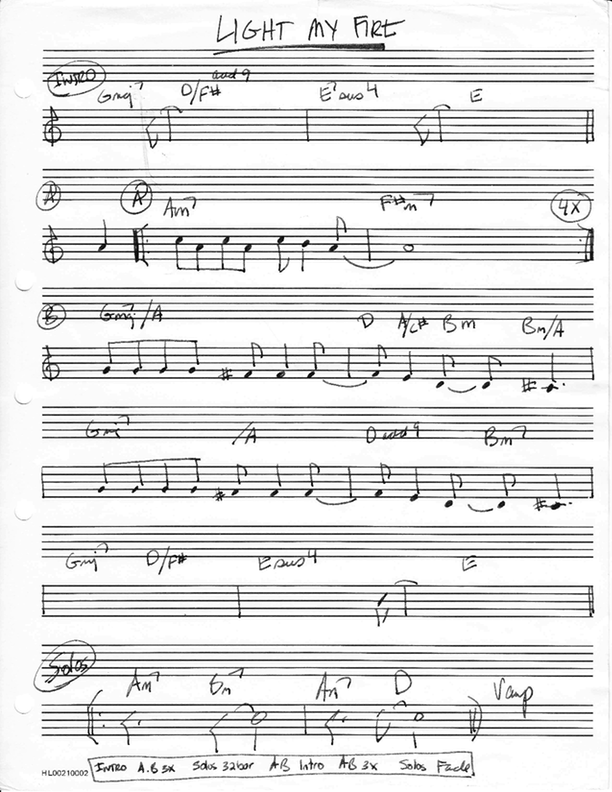
Light My Fire

Light My Fire is a song by The Doors which was recorded in August 1966 and released the first week of January 1967 on the Doors' debut album. Released as a single in April, it spent three weeks at number one on the Billboard Hot 100 chart, and one week on the Cash Box Top 100, nearly a year after its recording. A year later, it re-entered the Billboard Hot 100 in 1968 following the success of Jose Feliciano's version of the song, peaking at number 87.
Related Books & Charts
Related Books for Modal Interchange.
RMA1
Harmonic Analysis for Scale Selection and Chord Substitution

Harmonic Analysis is the understanding of the functional sequence of chords. It is the process used to analyze the harmonic structure of a progression, song or composition. This analysis is then used to make scale selections for improvisation and chord substitution.

A Selection of Books & Reference Charts that are recommended for creating a solid foundation with your chosen instrument and music in general.
These are Books & Reference Charts that apply to a majority of the lessons on LearningUkulele.com–Learning Ukulele with Curt .
Learning the Ukulele Fingerboard – C Tuning
Finally, learn the names of the notes of the ukulele fingerboard in C tuning .
Six Secrets of the Ukulele Fingering
Learn the six fingering principles to navigating the ukulele fingerboard. Fingering is one of the most universal topics. Book: Six Secrets of the Ukulele Fingering It there in one thing that give a ROI (corporate speak for return in your investment)—it is this— learning the f*cking notes of your OWN instrument. Sorry for the tough talks—but it is sooooo true!
Harmonic Analysis for Scale Selection and Chord Substitution
Harmonic Analysis is the understanding of the functional sequence of chords. It is the process used to analyze the harmonic structure of a progression, song or composition. Book: Harmonic Analysis for Scale Selection and Chord Substitution
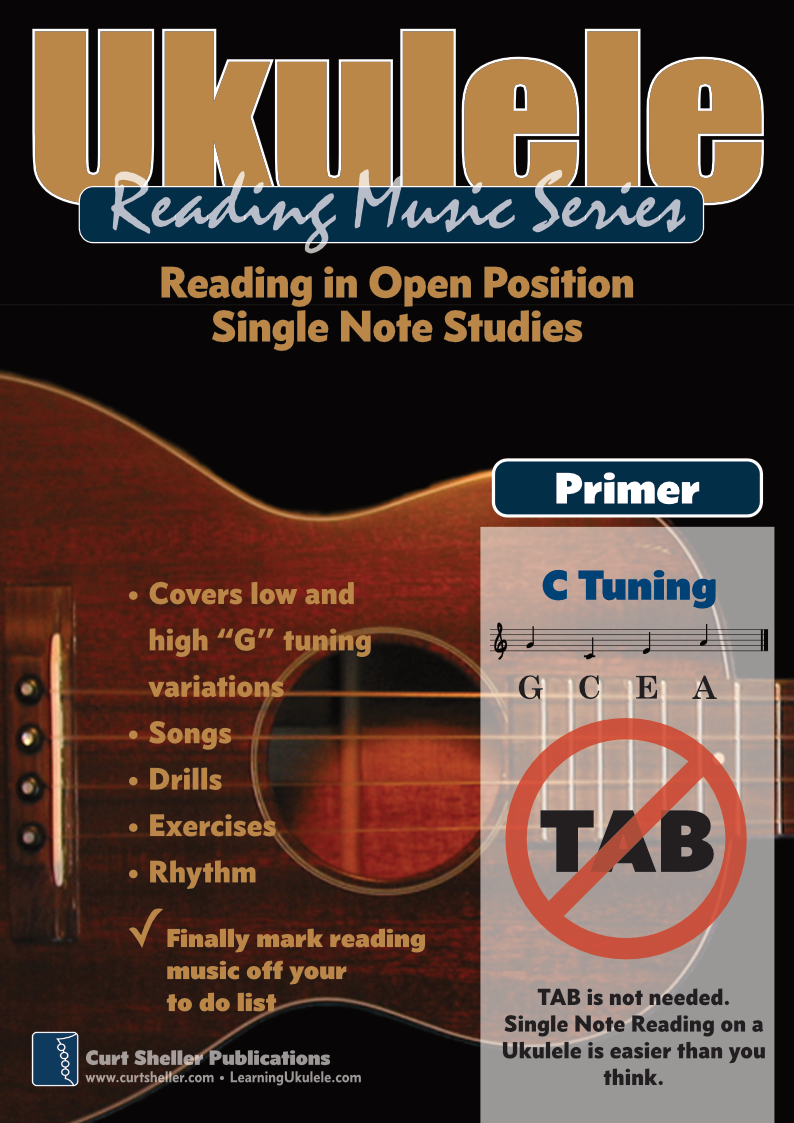
Ukulele – Reading Music Series – Primer

Learn to read single note melodies in the first/open position is a lot easier than you might think. Book: Ukulele – Reading Music Series – Primer
Daily Practice Material for the Contemporary Ukulele

An organized collection of daily practice and reference material for the contemporary ukulele player for developing the vocabulary and knowledge necessary for single note playing. Book: Daily Practice Material for the Contemporary Ukulele

Checkout the Books & Reference Charts for additional Handy, Dandy Reference Charts.
Reference Charts
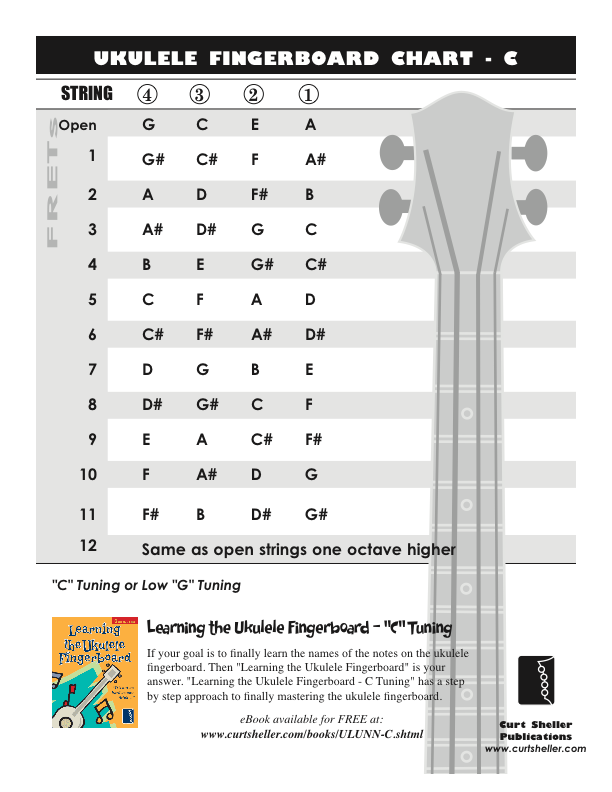
Ukulele Fingerboard Chart for C Tuning, Low or High G - G C E A

Ukulele Fingerboard Chart for C Tuning, Low or High G – G C E A
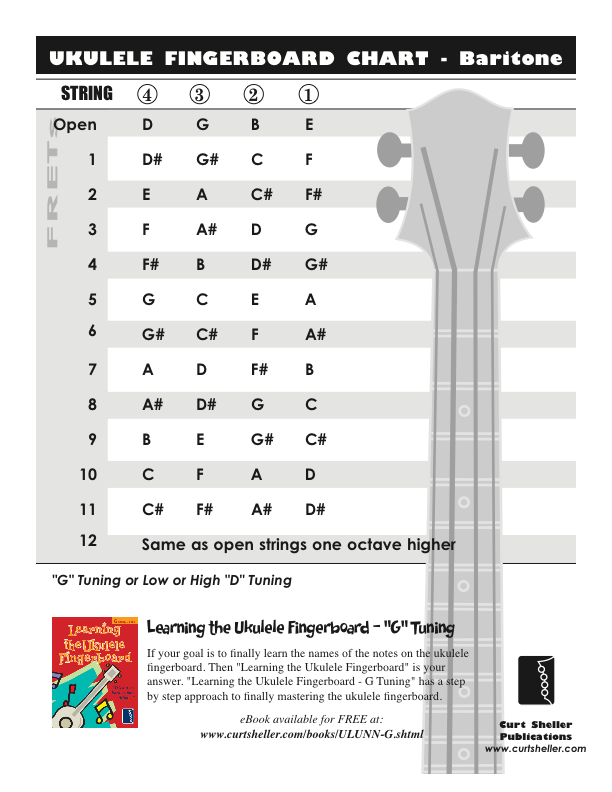
Ukulele Fingerboard Chart for G Tuning, Low or High A – D G B E
Ukulele Fingerboard Chart for G Tuning, Low or High A – D G B E

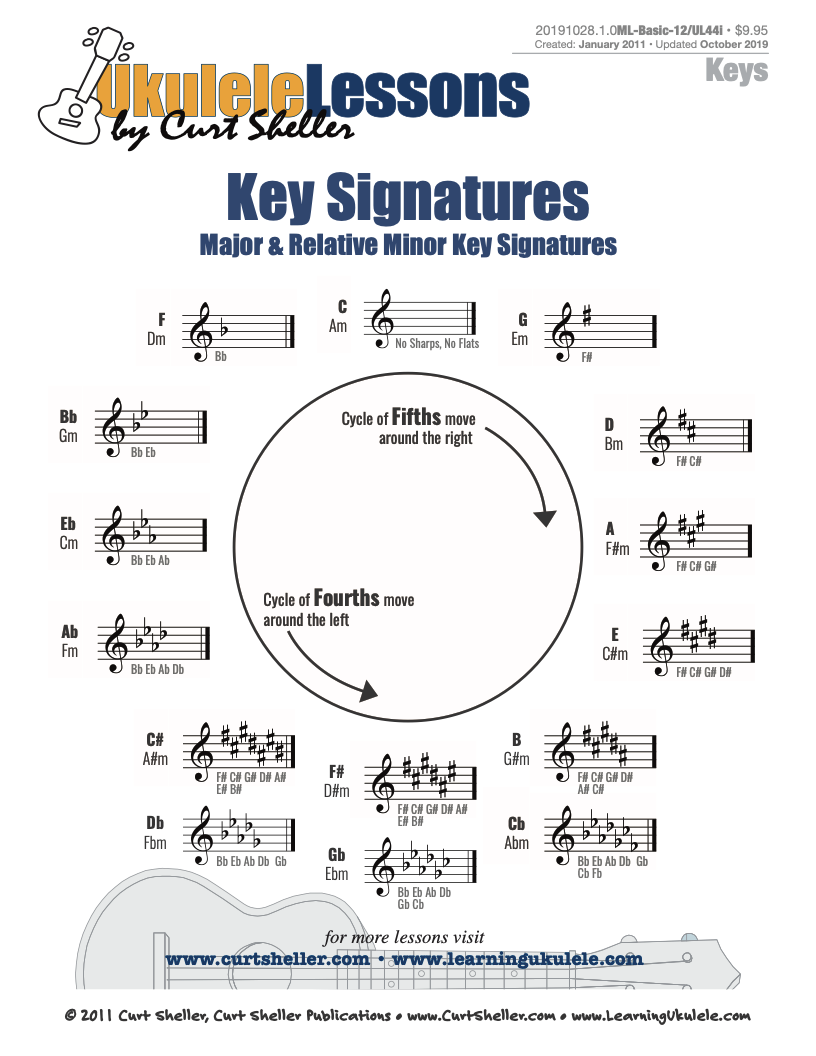
Circle of Fourths and Fifths – ANSI A & A4 sizes

A handy reference chart of all 15 major and relative minor key signatures. US Letter 8.5 x 11 sized (ANSI-A) , A4

Checkout the Books & Reference Charts for additional Handy, Dandy Reference Charts.
🚀 🚧 End of LearningUkulele.com Site Content 🚧 🌍
NOTE: PICS ARE FROM VARIOUS SOURCES. FAIR USE NOTICE:: This site contains images of which have not been pre-authorized. This material is made available for the purpose of analysis, teaching, comment and critique. The 'fair use' of such material is provided for under U.S. Copyright Law. In accordance with U.S. Code Title 17, Section 107, material on this site (along with credit and attributions to original sources) is viewable for educational and intellectual purposes - (frwebgate.access.gpo.gov). If you are interested in using any copyrighted material from this site for any reason that goes beyond 'fair use,' you must first obtain permission from the copyright owner.
art by Curt Sheller
On the web since 1992 and a Mac since 1987 (Mac II) • Serving up Ukulele content since 2003 ( 23 years ago )Lets Kanikapila!!! • And, since Sept 2020, happily on Pop!_OS Linux & COSMIC-DE and a System76 Thelio . Half the cost of the iMac and a real treat to use. I use it for ALL development work. Only wish the Affinity Suite of apps by serif where available on Linux (and I do know you can run them in Wine with a few hacks).
v20251117-0915.v4•L12.54.1 (PHP-8.2.23)
This sit has ben profesionaly red. awl tpyos aree free and no aditonal chrge • I'm blaming it on “jazz” fingers. “Aoccdrnig to rscheearch at Cmabrigde Uinervtisy, it deosn't mttaer in waht oredr the ltteers in a wrod are, the olny iprmoatnt tihng is taht the frist and lsat ltteer be at the rghit pclae. The rset can be a toatl mses and you can sitll raed it wouthit a porbelm. Tihs is bcuseae the huamn mnid deos not raed ervey lteter by istlef, but the wrod as a wlohe.
Site developed, hand-coded, and maintained by Curt Sheller, Curt Sheller Publications , 2050 Orlando Rd., Suite 101, Pottstown, PA 19464-2348 USA, North America, Northern Hemisphere, Earth, Solar System / Orion Arm of the Milky Way Galaxy, Virgo Supercluster, Laniakea Supercluster, Observable Universe ... and hosted on DigitalOcean , eCommerce using stripe , managed using Laravel Forge , and analytics (which we DO NOT share) by Plausible . See the LearningUkulele.com Site Credits page for credit to all the hardware, software, tools, and goodies we use to build this amazing site. A proverbial digital blob of music information.
Made with by Curt Sheller for LearningUkulele.com–Learning Ukulele with Curt and the ukulele community • © 1992 - 2026 Curt Sheller
Show your support!
Support LearningUkulele.com–Learning Ukulele with Curt development via a monthly membership or a one-time Forever membership! Learn more
Sign-Up Today …