
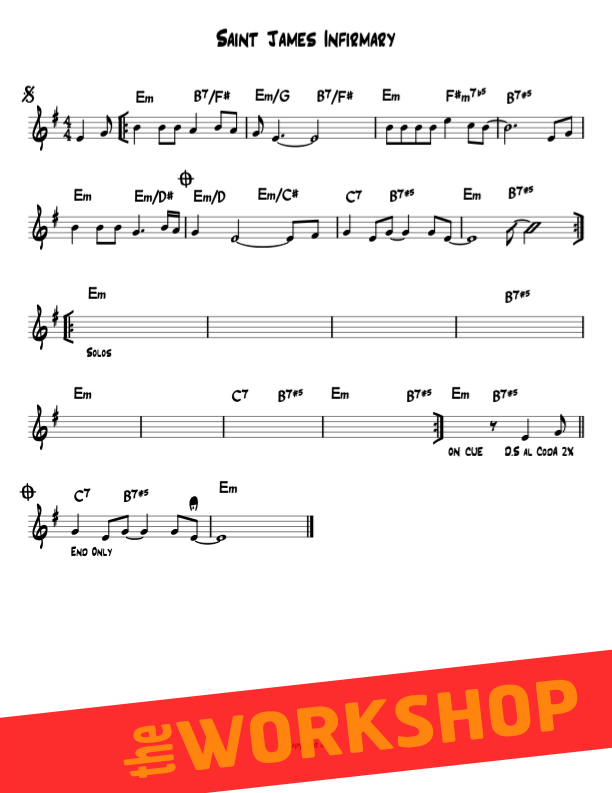
St. James Infirmary Blues is an American blues song of uncertain origin. Louis Armstrong made the song famous in his 1928 recording on which Don Redman was credited as composer. Later releases gave the name Joe Primrose, a pseudonym of Irving Mills. The melody is 8 bars long, unlike songs in the classic blues genre, where there are 12 bars. It is in a minor key, and has a 4/4 time signature, but has also been played in 3/4.


Sign-in or Register to Attend, or view this Workshop or view a previous workshop's video.
St. James Infirmary Blues is an American blues song of uncertain origin. Louis Armstrong made the song famous in his 1928 recording on which Don Redman was credited as composer. Lter releases gave the name Joe Primrose, a pseudonym of Irving Mills. The melody is 8 bars long, unlike songs in the classic blues genre, where there are 12 bars. It is in a minor key, and has a 4/4 time signature, but has also been played in 3/4.
"St. James Infirmary Blues" is sometimes said to be based on an eighteenth-century traditional folk song called "The Unfortunate Rake" (also known as "The Unfortunate Lad" or "The Young Man Cut Down in His Prime") about a soldier who uses his money on prostitutes and then dies of venereal disease. But the familiar recorded versions (such as Armstrong's) bear little relation to the older traditional song. The earliest known form of this song was called "The Buck's Elegy" and is set in Covent Garden, London.
Video(s)
Workshop Downloads

MuseScore Resources
St. James Infirmary Blues - Ukulele Melody and Chord Arrangement with Bass by Curt Sheller
Workshop Download


.jpg)